I tried to test Hops four times before I got in. Every test account I created was flagged and restricted by Hops’ own security check, and only an existing personal account, signed in by its owner, opened the workspace. Once I was inside, the product itself was good: three tasks, all finished in about a minute each, for 610 credits out of a generous 20,000 free. That split is the whole review. Hops works well. Getting in is the hard part.
Hops launched publicly on 10 November 2026, two days before my test, after more than 2,500 teams used it in early access. It comes from For Good AI, led by Wrike founder Andrew Filev. I found no independent customer reviews for it anywhere as of 12 November 2026. That is the point of this review: a brand new tool, tested on its free tier, with exact credit counts, so you can judge it before you pay.
What Is Hops?
Hops is a collaborative AI workspace. Shared chats, docs, slides, tables, and dashboards live in one place, with one AI agent working in the shared workspace, and more than 2,000 integrations. The pitch is that what one person teaches Hops, the whole team can use, and that you pay only for AI work through credits, with no per-seat fees. The free Go plan includes unlimited teammates, chat, docs, slides, and tables, scheduled automations, featured integrations, and 5 GB of storage.
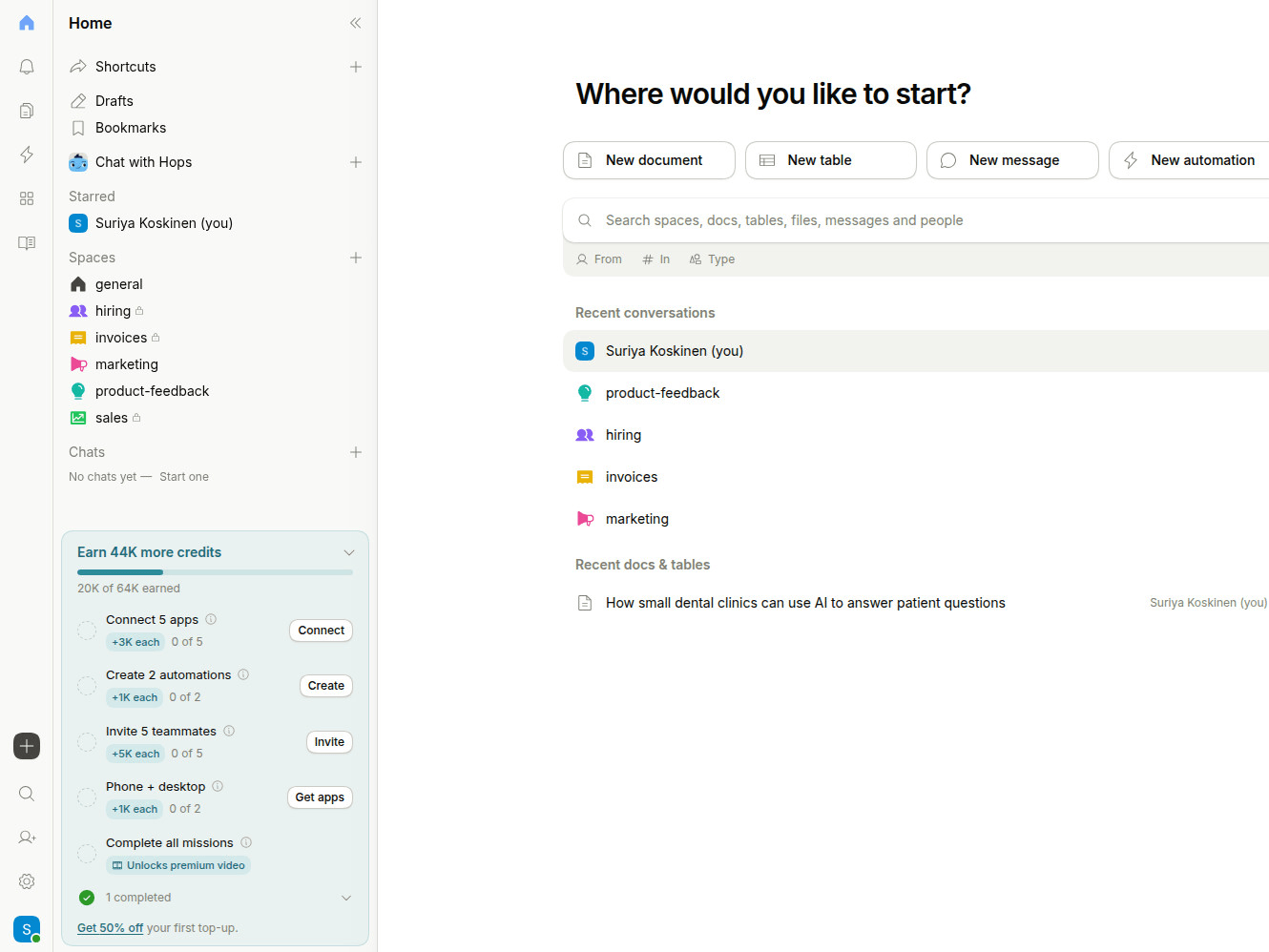
Onboarding asks you to connect your work email and the apps you work in. Step 2 of 3, “Spend less time in your inbox”, offers 3,000 free credits when you connect Gmail. Step 3 of 3, “Connect the apps you work in”, suggests Slack, Google Calendar, Google Drive, and Notion, and promises up to 15,000 free credits, 3,000 for each app you connect. I connected nothing in my test, and Settings, Connections confirmed “No connections are available to you”. The rewards panel confirmed the same maths: connect 5 apps at 3,000 each, 0 of 5 done.

Hands-On Test: How Hops Actually Performed
In line with our editorial testing policy, first, a heads-up on sign-in, because Hops runs an aggressive automated fraud filter (`auth.hops.ai/security/denied`). When I first tried signing up with a disposable email and a fresh test address, Hops verified the email code and then immediately blocked the account with: “Your account has been flagged and access has been restricted.” Signing in with an established Google account opened the workspace normally, with no credit card, phone number, or ID check required.
My starting balance at 17:21 EET was 20,000 free credits. The rewards panel showed “Earn 44K more credits” and “20K of 64K earned”, with the completed mission “Create your account, plus 20K”. The remaining missions to 64K are connect 5 apps at 3,000 each, create 2 automations at 1,000 each, invite 5 teammates at 5,000 each, and phone plus desktop at 1,000 each. Settings, Credits and billing showed “Credit balance 20K credits left, 0 used from Nov 12 to Dec 11, 2026”. The plan is “Go, Active, Free members. Pay-as-you-go credits.” Automatic top-ups were Off, “No payment method added”, and “No commitment required”.
Test 1 was a 600-word blog post: “how small dental clinics can use AI to answer patient questions”. I sent it at 17:21 and the reply came at 17:22, in about 1 minute, and the draft was saved as a document in the personal space under that title. The body ran to about 611 words, about 622 including the title, so the target was met. The structure was solid: an intro, the questions patients ask most, where AI fits (website chat, email and after-hours, booking help, aftercare), four setup steps, when to hand over to a person, privacy (GDPR and HIPAA), and a small first step. The quality was good and practical. One flaw: the draft left a placeholder for the clinic phone number, “[number]”, which Hops itself flagged in its reply. The cost was about 407 credits. That matters, because Hops’ own pricing FAQ puts a 600-word document at 75 to 250 credits. My doc cost about 407, well above the published range. Hops’ terms say credit costs may vary by model and feature, which explains the gap, but the published range still understates what I paid.
Test 2 was a meeting-notes summary. I sent invented BrightSmile Clinic huddle notes (Anna, Ben, Carla, Dan) at 17:23 and the reply came in under a minute, for 77 credits. This was the best output of the test: an accurate short summary, an action-item table with owner and due date, and the decisions listed. It correctly left “Due date, Not set” for the waiting-room slides, because no date was in the notes, instead of inventing one. It also flagged that the notes do not say who runs the 2-week AI phone-assistant trial or when it starts. That is honest, careful work.
Test 3 was a research summary: “AI voice agents for small clinics in 2026”. Sent at 17:24, replied in under a minute, for 126 credits. It was a short headed summary covering capabilities (24/7 calls and the benefits), example prices (“US prices often run $299 to $900 a month per location” and “simple AI chatbots and phone tools run $25 to $100 a month”), named options (Dentina, Dentovox, TensorLinks, Viva AI; Mango Voice, Peerlogic, Weave; MedReception AI, MedReceptionist; GoHighLevel), risks (wrong answers, clinical safety limits, privacy under GDPR, HIPAA, DPA and BAA, the EU AI Act disclosure duty, and integration gaps), and 5 linked sources. It explicitly warned that almost all published prices are from US vendors and to check European availability and GDPR terms. I did not independently verify the specific vendor price claims in that summary, so treat them as Hops’ output, not as checked facts.
My ending balance was 19,390 credits (“19.4K credits left”, 610 used from Nov 12 to Dec 11, 2026). Total test spend was 610 of the 20,000 free credits: about 407 for the blog post, 77 for the meeting summary, and 126 for the research summary. The only other activity was a one-word “hi” from the account owner. At that rate the free grant covers a lot of work, but the blog post shows the per-task cost can run well above the published ranges.

Free Plan vs. Real Pricing (And Hidden Limits)
The free plan costs $0 and needs no card. It gives 20,000 free credits, unlimited teammates, chat, docs, slides, and tables, the AI teammate @Hops, scheduled automations, featured integrations, and 5 GB of storage. Top-ups cost $20 per 20,000 credits, and purchased credits are valid for 12 months. Paid plans, checked on the official pricing page on 12 November 2026:
| Plan | Price | Credits | Key features |
|---|---|---|---|
| Pay as you go | $0 per user a month | 20,000 free credits | Unlimited teammates, chat, docs, slides, tables, scheduled automations, 5 GB storage |
| Team AI | $200 a month | 200K credits, 1 to 4 people, packages scale to 120M credits for 3,000 people | Event-based automations, per-user spending caps, SSO (SAML and OIDC), 100 GB storage, billed monthly |
| Enterprise | Custom | Custom | Directory sync (SCIM), security dashboard, SOC 2 Type II, ISO 27001 and ISO 42001, DPA and custom terms, full integration library, bring your own API key, dedicated support |
Hops’ own typical task costs, from the pricing FAQ, are a quick answer 100 to 300 credits, a web lookup 50 to 200, a meeting-notes summary 25 to 100, a 600-word doc 75 to 250, a weekly automation setup plus first run 400 to 1,000, and a deep research report 500 to 1,500. Hops says “At $20 for 20,000 credits, even a deep research job runs about a dollar.” My measured costs were a meeting summary at 77 credits, inside its range, a research summary at 126, and a 600-word doc at about 407, above its range. One warning: the pricing FAQ control “Show all 18 questions” would not expand in my test, so the remaining FAQ answers were not read. The in-app billing page says “No commitment required”, and no annual discount is shown anywhere.
I checked for promos on the official pricing page and in the app. The in-app rewards panel offers “Get 50% off your first top-up”: $10 instead of $20 for 20,000 credits, $25 instead of $50 for 50,000 credits (marked Recommended), $50 instead of $100 for 100,000 credits, or a custom amount. The line item reads “First top-up discount (50% off up to $1,000)”. No expiry date was shown and no promo code was required. I closed the dialog with Cancel and bought nothing. The pricing page FAQ also carries a launch offer: the full 2,000 plus integration library is part of Enterprise, and “for a limited time during our launch it’s also included on Go at no extra cost”, with no code and no end date given. No student discount, launch discount code, or annual deal was found on the official pricing page or in the app, and I did not use third-party coupon sites.
Terms flag: the terms, last updated 30 October 2026, say subscriptions auto-renew unless cancelled before the next renewal, and a trial that needs a payment method converts to paid the day after the trial ends unless cancelled. Hops may terminate a subscription or account at any time for any or no reason, with the sole remedy a prorated refund of prepaid unused subscription fees, and top-up credits are non-refundable except as required by law. Credit costs may vary by model and feature. The content licence is non-exclusive, transferable, sublicensable, and royalty-free, but Hops says it does not use your content to fine-tune or train AI models unless you opt in, and output is assigned to you, with no warranty of accuracy and a human expected to confirm output before material use. Sensitive data, including protected health information, payment card info, government ID numbers, and financial data, must not be included unless Hops expressly permits it, which matters directly for clinics. The terms also impose binding arbitration with jury-trial and class-action waivers, and say terms may change, with non-material revisions effective immediately on posting. One account per individual, no automated account creation, and Hops may require identity verification and suspend, restrict, or terminate at its sole discretion.

Pros
- Generous free grant: 20,000 free credits with no card, and my three tests used only 610 of them.
- Fast, genuinely good output: all three tasks replied in about a minute or less, and the meeting summary was excellent, with an accurate action table and no invented due date.
- Honest where it matters: the summary flagged missing owners and dates instead of guessing, and the research summary warned that its prices were mostly US vendors.
- No per-seat fees: the free plan includes unlimited teammates, and top-ups are a flat $20 per 20,000 credits, with 50% off the first top-up.
Cons
- Sign-in flagging blocks new users: every test account I tried was flagged and restricted, and only an existing personal account signed in by its owner worked.
- Doc cost beat the published range: the 600-word blog post cost about 407 credits against Hops’ own 75 to 250 range.
- Termination at will in the terms: Hops may terminate an account at any time for any or no reason, and top-up credits are non-refundable except as required by law.
- Health data limits for clinics: protected health information must not be included unless Hops expressly permits it, so a clinic cannot just paste patient data in.
What Real Users Are Saying
I have to be direct here: I found no independent customer reviews for Hops. I checked G2, Trustpilot, Capterra, Product Hunt, Reddit, Hacker News, X, and YouTube, and none of them returned a verified user review for hops.ai. G2, Trustpilot, and Capterra have no hops.ai profile, and the hits were unrelated products with similar names. No Product Hunt listing or launch post for hops.ai was found at all. Do not confuse it with “Hops: Chat to build backoffice” on hopsoffice.com, a different product from Product Hunt in 2024.
What exists instead is vendor material. The homepage carries three testimonials, from the CEOs of Fronted, PumaMesh, and Keenable, praising shared context and replacing Slack. The launch press release quotes Discern Security’s CEO saying Hops replaced major tools like Slack and Jira for his sales and marketing teams. Launch coverage repeats the shared-methods pitch, the permissions and approval model, and the security claims (SOC 2 Type II, ISO 27001 and ISO 42001). None of this is independent user evidence, so I am not presenting it as such. One pricing conflict to note: Unite.AI says the pay-as-you-go plan includes 5,000 free credits, while the official pricing page says 20,000, and my test confirmed 20,000. Trust the official page.
Who Should Use Hops (And Who Should Skip It)
Use Hops if you want a shared AI workspace for a small team, you have 20,000 free credits to spend, and your work is mostly drafting, summarising, and research, where my test showed it is fast and careful. The meeting summary alone is worth trying it for. Skip it, for now, if you cannot get past sign-in: every test account I tried was flagged, and the only way in was an existing personal account signed in by its owner. Skip it too if you need to paste patient or other sensitive data into it, because the terms restrict protected health information unless Hops expressly permits it, and if you want independent reviews before you trust a two-day-old tool with a subscription, wait: there are none yet.
Gamma Review
If you need presentation decks and slide outlines generated from prompts, explore our hands-on Gamma review.
Frequently Asked Questions
Is Hops really free?
Yes, the Pay as you go plan costs $0 with no card and gives 20,000 free credits. In my test the balance started at 20,000 and three tasks used 610. You can earn up to 44,000 more through in-app missions, such as 3,000 credits for each app you connect. Top-ups cost $20 per 20,000 credits, with 50% off your first top-up.
Why was my Hops account flagged at sign-in?
In my test, every test account I created was flagged and restricted at auth.hops.ai/security/denied, with the message “Your account has been flagged and access has been restricted.” The only account that worked was an existing personal account signed in by its owner. The denied page says to contact support at support@hops.ai if you believe it is a mistake. I did not contact support in this test.
How much does Hops cost per month?
Pay as you go is $0 a user a month, with top-ups at $20 per 20,000 credits, and the first top-up is 50% off, so $10 for 20,000 credits. Team AI is $200 a month for 200,000 credits for 1 to 4 people, with packages scaling to 120M credits for 3,000 people. Enterprise is custom priced. No annual discount was shown.
Can a small clinic use Hops with patient data?
Be careful. Hops’ terms say protected health information must not be included unless Hops expressly permits it, and the research summary in my test flagged privacy under GDPR and HIPAA, data processing and business associate agreements, and the EU AI Act duty to tell callers they are speaking to an AI. Hops also says a human must confirm output before material use. Do not paste patient data into Hops without checking that permission first.