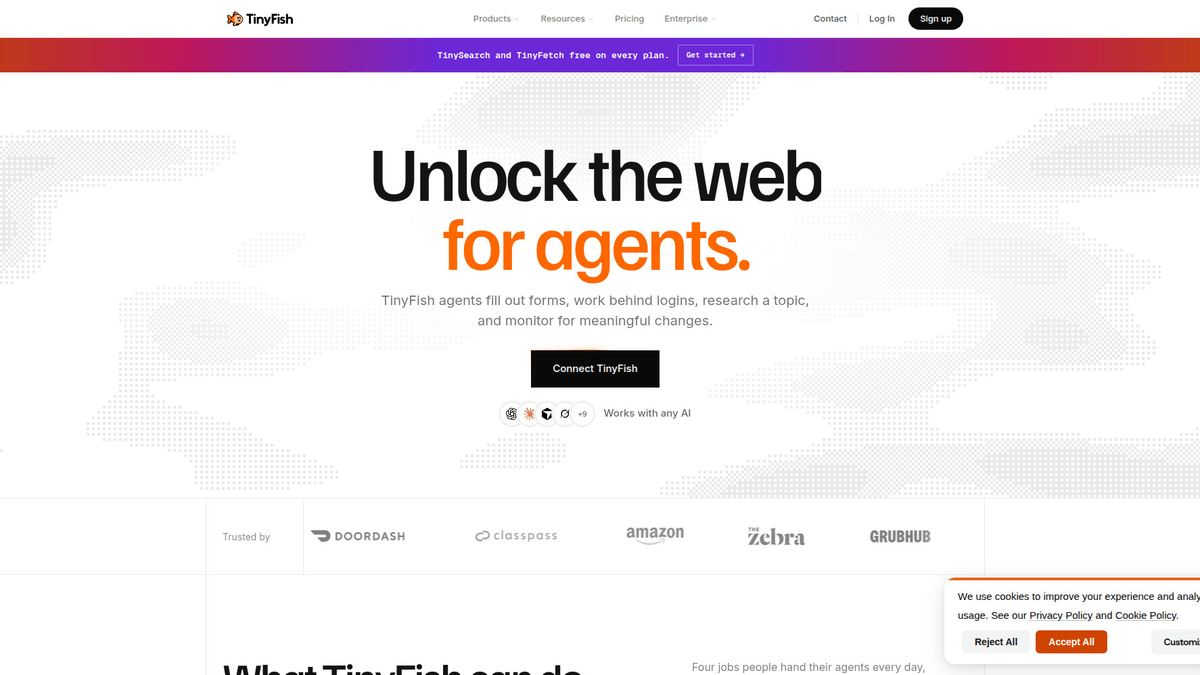
I signed up for TinyFish with a free email account (no credit card required) and started with $8.00 in free credit in the wallet. I then ran two TinyResearch Deep reports for $2.00 each and built one 10 row TinySet dataset for $0.40, and $3.60 was left when I finished. The research reports were strong, cited, and honest about conflicting sources. The dataset was not: 6 of its 10 rows had no launch date at all, despite my prompt asking for November 2026 launches only.
TinyResearch and TinySet launched on Product Hunt on 6 November 2026, as new products on the TinyFish platform, which came out of stealth in August 2025. There are no independent customer reviews for these two products yet, so this review is a hands-on test of the free $8 wallet, with exact timings, source counts, and wallet balances, so you can judge them before you top up.
What Is TinyResearch and TinySet?
TinyResearch turns one hard question into a cited report formatted for a decision. TinySet turns one prompt into a structured dataset built from public web pages, up to 250 rows, with each value backed by a page it read. Both live on the same TinyFish account and wallet as TinySearch, TinyFetch, TinyAgent, TinyBrowser, and TinyMonitor, and the same tools can be handed to ChatGPT, Claude, Cursor, Codex, or your own product through an API, MCP server, CLI, and SDKs.
TinyResearch has two modes. Deep costs $2.00 per run and Max costs $3.00 per run, and you only pay for runs that finish. TinySet costs $0.10 per row, and skipped, failed, or cancelled rows are free. TinySearch and TinyFetch are free on the Hobby tier. There is no subscription, no monthly minimum, and no card to sign up. You top up the wallet when the $8 welcome bonus runs out, with a $10 minimum.

Hands-On Test: How TinyResearch and TinySet Actually Performed
In line with our editorial testing policy, I signed in on 12 November 2026 using a Gmail address and a 6-digit email verification code (public disposable email domains were rejected). No credit card or payment method was requested at sign-up, and my starting wallet balance was $8.00 as a welcome bonus.
Test 1 was TinyResearch Deep, at $2.00. My question was to compare the best free AI video generation and editing tools for creators in 2026, and say which are best for YouTube Shorts and TikTok creators, with sources. It completed in 8 minutes 15 seconds. The report was titled “AI Video Generation and Editing Tools for Creators: 2026 Comparative Report”, current as of 12 November 2026, with 43 sources, 25 queries searched, and 20 sources read. Its recommendation was Google Flow, free at 50 credits a day, plus CapCut, free, with Kling Standard at about $6.60 a month annual and Opus Clip Starter at $15 a month for repurposing. The quality impressed me: numbered citations, a comparison table of 16 tools, and it explicitly flagged conflicting sources, for example on Pika free credits and the Kling 66 credit status, and caveats such as free tier erosion, Hailuo litigation, and CapCut US availability. The wallet fell from $8.00 to $6.00.
Test 2 was TinySet, at $0.40. My prompt asked for a table of exactly 10 new AI tools launched in November 2026, with columns for tool name, launch date in November 2026, what it does, official website URL, and free plan available. The schema review step appeared first, with a default of 100 rows at about $10.00, so I changed Max rows to 10 at about $1.00 before building. The build was approved at 15:22 and complete by 15:25, about 6 minutes end to end. The result had 10 rows: beacon.sh and Wanaka Studio dated Nov 2, Rankfender v3.0 and Kodivo dated Nov 6, and 6 rows with no launch date at all, shown as a dash. The actual charge was only 4 rows at $0.10, which is $0.40, and those 4 billed rows are exactly the 4 rows that had a launch date, so the 6 date-less rows appear to have been treated as unpaid or skipped. The wallet fell from $6.00 to $5.60. The quality caveat is real: 6 of 10 rows have no launch date despite the prompt requiring November 2026 launches, and at least one entry, MarkItDown, is a Microsoft open source project that predates November 2026. Launch date verification is weak, so check dates yourself before you trust a TinySet dataset.

Test 3 was a second TinyResearch Deep, at $2.00. My question was to compare the best free AI image generation tools for creators in 2026, for social media thumbnails and blog illustrations, with sources. It completed in 7 minutes 35 seconds. The report was titled “Free AI Image Generation Tools for Creators in 2026: A Comparative Decision Memo”, with 39 sources, 17 queries searched, and 21 sources read. Its recommendation was Leonardo AI at 150 tokens a day, plus Ideogram for text and Canva for workflow, with paid step-ups of Ideogram Plus at $15 a month annual and Adobe Firefly Standard at $9.99 a month for commercial safety. This run showed a research plan step that was auto-approved with no response before searching started. The wallet fell from $5.60 to $3.60.
My ending wallet balance was $3.60 of the $8.00 welcome bonus, so the three tests cost $4.40 in total. All three usage charges are marked in the billing history as pending, recorded and awaiting confirmation. Auto-reload is off. I did not test TinyResearch Max mode, TinyAgent, TinyBrowser, or TinyMonitor, and I did not use the free TinySearch or TinyFetch calls, so this review covers TinyResearch and TinySet only, not the whole TinyFish platform.

Free Plan vs. Real Pricing (And Hidden Limits)
There is no subscription and no free plan with a monthly allowance. You get $8.00 once as a welcome bonus, and then you pay as you go from the wallet. TinySearch and TinyFetch are free on the Hobby tier, which is the real free tier here, but I did not exercise those calls in this test. The Builder tier, shown in an in-app dialog I viewed but did not upgrade to, trades free Search and Fetch for metered rates and higher limits, with Agent 5 at once instead of 2.
Paid pricing, checked on the official pricing page on 12 November 2026, in USD:
| Item | Price | Free or limit |
|---|---|---|
| TinySearch | $0.00 per request | Free, 30 a minute, 500 an hour |
| TinyFetch | $0.00 per URL | Free, 150 URLs a minute, 1,000 a day |
| TinyAgent | $0.016 per step | 2 concurrent runs on Hobby |
| TinyBrowser | $0.002 per minute | 5 concurrent sessions |
| TinyMonitor | $0.005 per check | Failed checks free |
| TinyResearch Deep | $2.00 per run | Only charged for runs that finish |
| TinyResearch Max | $3.00 per run | Only charged for runs that finish |
| TinySets | $0.10 per row | Skipped, failed, or cancelled rows free |
| Welcome bonus | $8.00 once | No card to sign up |
| Wallet top-up | $10 minimum | Card required only for top-up |
I checked for promos on the pricing page, the in-app banner, and the Product Hunt launch post, and I found no launch code or discount. The Product Hunt post, posted 5 November 2026 with maker comments on 6 November, contains no promo code in its description or comments. The only verified official offers are for students, $35 wallet credit automatically with an eligible academic email, while personal Gmail is explicitly not eligible, and for startups, Tier 1 up to $7,000 in value and Tier 2 up to $12,000, with 50 percent off TinyAgent and TinyBrowser for 24 months and $500 wallet to start. There is also an in-app offer to earn $5 in wallet funds by completing 4 setup tasks, which I did not pursue. No annual deal exists, because there is no subscription at all.
Terms flag: the Terms of Service, effective 17 August 2026, say the $8 promotional balance expires 12 months after it is granted if no period is stated, may be modified or revoked, is non-refundable, and is forfeited on termination. Usage overruns can push deductions above your balance, and you remain liable, with TinyFish able to recover a negative balance from your next top-up or by charging a saved payment method. Auto-reload is opt-in and authorises charging a saved card whenever the balance falls below a threshold. You keep ownership of your data, but you grant TinyFish a licence to use it to train, fine-tune, and evaluate its AI and ML models, with safeguards against disclosure to other customers, and to publish aggregated or de-identified data. There is also binding individual arbitration with a class-action and jury-trial waiver, with a 30 day opt-out by email, and liability is capped at the greater of $100 or 12 months of spend.

Pros
- Strong research reports for $2: two Deep reports in 8 minutes 15 seconds and 7 minutes 35 seconds, with 43 and 39 sources, numbered citations, and honest flags for conflicting sources.
- Real free start, no card: $8.00 welcome bonus on signup, and TinySearch and TinyFetch are free on the Hobby tier, with a $10 top-up minimum only when you choose to pay.
- Transparent per run pricing: $2.00 for Deep, $3.00 for Max, $0.10 per TinySet row, charged only for finished runs and completed rows, with the wallet balance shown on every step.
- Verified student and startup offers: $35 wallet credit for eligible academic email, and startup tiers up to $7,000 and $12,000 in value, with applications open.
Cons
- TinySet date verification is weak: 6 of 10 rows in my dataset had no launch date, despite the prompt requiring November 2026 launches, and MarkItDown predates November 2026.
- Your data can train their models: the terms grant TinyFish a licence to use your data to train, fine-tune, and evaluate its AI and ML models.
- Overrun liability: in-progress usage can push deductions above your balance, and you remain liable, with recovery from your next top-up or a saved payment method.
- No reviews for these two products yet: 0 independent customer reviews were found for TinyResearch or TinySet, and Max mode, TinyAgent, TinyBrowser, and TinyMonitor were not tested here.
What Real Users Are Saying
I have to be direct here: I found no independent customer reviews for TinyResearch or TinySet themselves. I checked G2, Trustpilot, Product Hunt, and Reddit, and none of them returned a verified user review of the two new products. The Product Hunt launch post has maker comments only, no user reviews. The only public signal for the two products is the vendor’s own benchmark post, which reports TinyResearch at 51.74 out of 100 on DRACO and 46.42 out of 100 on DeepResearch Bench II, plus 30 or more example reports at tinyfish.ai/deep-work.
What does exist is a platform level record. TinyFish as a platform has a G2 rating of 4.3 out of 5 from 109 reviews, with the count showing as 112 on another G2 page fetched the same day, so I am citing the lower figure. Positive themes are the generous free quota and free Search and Fetch, smooth onboarding with no card, easy MCP setup, and clean Markdown fetching in real time, with one reviewer reporting a 98 percent success rate over 100 fetches for an AI news tool they built. Common complaints are that crawling capabilities need improvement, and one reviewer titled their review “It is getting there but not there”. Those reviews are mainly about Search, Fetch, and Agent, not about TinyResearch or TinySet, so I am not presenting them as reviews of the two products in this review. No Trustpilot profile was found for TinyFish, and no billing or refund complaints surfaced in the G2 snippets I fetched.
Who Should Use TinyResearch and TinySet (And Who Should Skip It)
Use TinyResearch if you need a cited, decision-ready report on a hard question and $2.00 per report feels fair for 8 minutes of work across dozens of sources, and use TinySet if you need a quick structured table from public pages and you are willing to check the values yourself. The $8.00 welcome bonus covers four Deep reports, or two reports plus a 10 row dataset, with change, so try both before you top up. Skip TinySet if you need verified launch dates or exact dates in a dataset, because my test shows it leaves dates blank and can include entries that predate your window. Skip the platform if you are not comfortable with the terms letting TinyFish use your data to train its models, or with overrun liability on a wallet with a saved payment method. And if your main need is TinyAgent, TinyBrowser, or TinyMonitor, wait for a review that tests those, because this one does not.
Paperguide Review
If you need academic literature discovery, PDF citation search, and research drafting, explore our Paperguide review.
Frequently Asked Questions
Is TinyFish really free?
Yes, to start. Every new account gets $8.00 in the wallet with no card, and TinySearch and TinyFetch are free on the Hobby tier. TinyResearch Deep costs $2.00 per run, Max costs $3.00, and TinySets cost $0.10 per row, so the $8.00 bonus covers about four Deep reports. Top-up starts at $10 and needs a card.
Does TinyResearch add a watermark on the free plan?
No. TinyResearch and TinySet are not image tools, so there is no watermark. Outputs are text reports and datasets. Note that the terms grant TinyFish a licence to use your data to train and fine-tune its models, so do not send data you cannot share.
How much does TinyResearch cost per month?
There is no monthly plan. TinyFish is pay as you go from a wallet: Deep reports $2.00 each, Max reports $3.00 each, TinySets $0.10 per row, TinyAgent $0.016 per step, TinyBrowser $0.002 per minute, and TinyMonitor $0.005 per check. You only pay for finished runs and completed rows.
Can you use TinyFish commercially?
Yes, the platform is built for commercial and agent use, through API, MCP, CLI, and SDKs, but read the terms first. Users must be 18 or older, you may not use the service or its outputs to train a competing product, and you grant TinyFish a licence to use your data to train its models. Rates may rise on 14 days notice, and refunds apply only to a first purchase within 14 days, less amounts used.