I tested Ai2 Asta on a real research question, and my quick take is simple: it is the strongest free research assistant I have tested so far. Find papers, Generate a report, and Analyze data cost no credits at all, the citations I checked were exact matches, and the new Theorizer produced 5 testable theories in about 30 minutes for 65 credits. It scores 7.0, Worth trying.
One note before you read on: Asta itself launched in August 2025, so it is not a brand-new tool. Theorizer is the new part, launched in Asta on 19 November 2026, and that is what this review tests firsthand, alongside the core research tools. Ai2 covers the token costs, there is no paid plan, and the free grant is 1,000 credits, with 100 more on request when you fall below 120.
What Is Ai2 Asta?
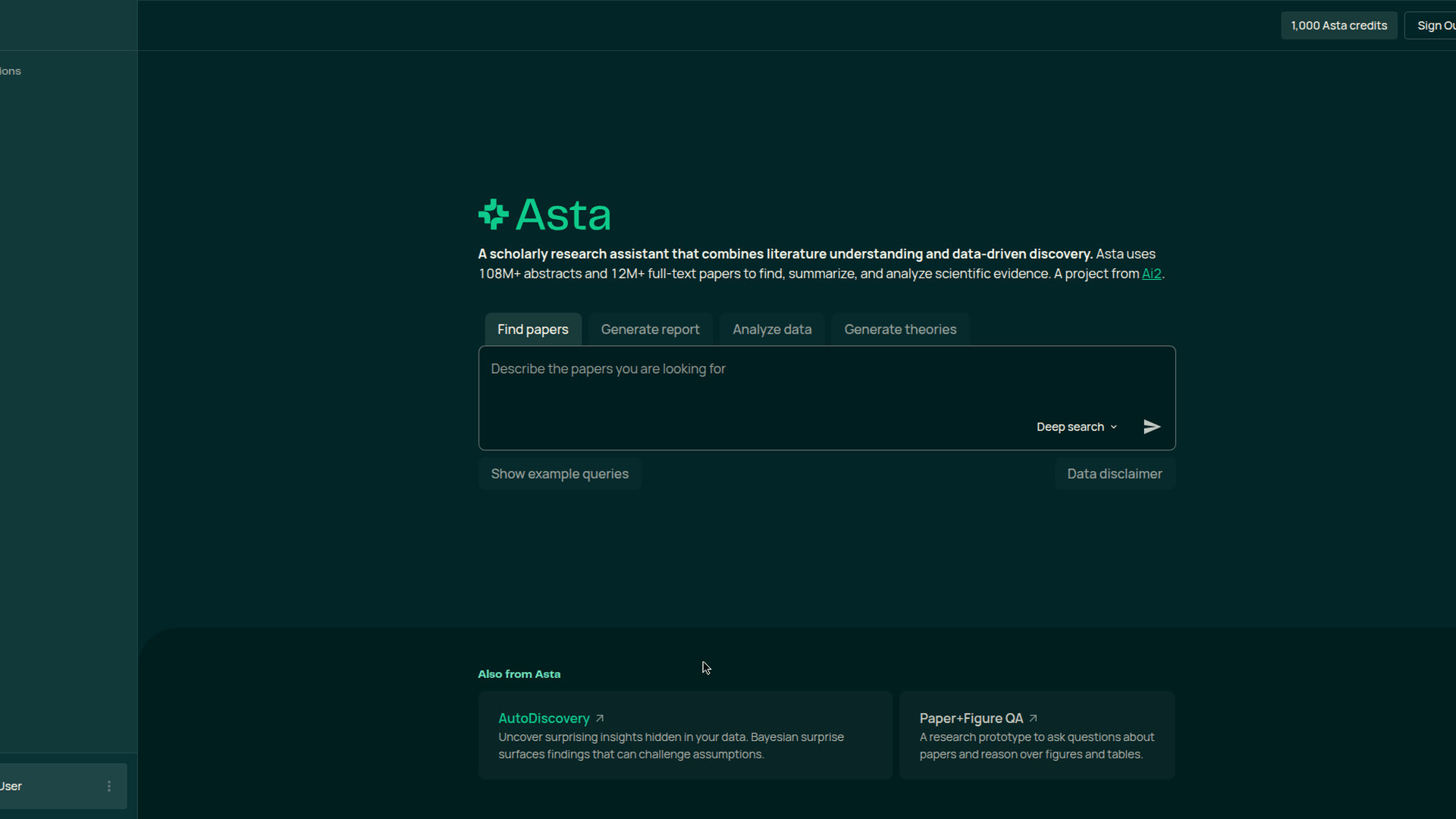
Ai2 Asta is a scholarly research assistant from the Allen Institute for AI (Ai2), a nonprofit research institute in Seattle, founded in 2014 by the late Paul Allen. It combines literature understanding and data-driven discovery, using 108M+ abstracts and 12M+ full-text papers to find, summarize, and analyze scientific evidence. The four tabs on the homepage are Find papers, Generate report, Analyze data, and Generate theories.
Theorizer is Asta’s newest agent. It takes an observation or research question, finds up to 100 relevant papers, extracts findings, and generates candidate theories, each with testable hypotheses, predictions, and an evidence table. Ai2 also open-sourced the Theorizer code, and published the paper ‘Generating Literature-Driven Scientific Theories at Scale’, by Jansen, Clark, Downey, and Weld. The system behind that paper created 2,856 theories by synthesizing evidence from 13,744 scientific papers.
Hands-On Test: How Ai2 Asta Actually Performed
Following our editorial testing policy, I signed up by email on 22 November 2026 with no credit card or phone number required. The account started with exactly 1,000 Asta credits and ended with 935, with all 65 credits used by Theorizer. No card, no phone, and no payment were needed at any point.

Test 1, Find papers, 0 credits, 1m 1s. I asked ‘What evidence links sleep disruption to amyloid beta accumulation in Alzheimer disease?’ Asta found 75 papers: 69 Perfectly Relevant, 5 Relevant, 1 Somewhat Relevant, with a relevance explanation and score for each paper, and subtopics including Human Longitudinal, NREM Sleep, and the Glymphatic System. It also gave a 5-point summary with linked citations, and rated its own confidence as very high. The result felt fast and focused, not a generic search dump.
Test 2, Generate a report, 0 credits, 1m 47s. I used the same question. The report was titled ‘Sleep Disruption and Amyloid-beta Accumulation in Alzheimer Disease’, with 5 sections and 59 paper references, 56 papers cited. I checked 2 citations by hand on Semantic Scholar, and both were exact matches: Shokri-Kojori et al., PNAS 2018, on beta-amyloid accumulation after one night of sleep deprivation, and Xie et al., Science 2013, on sleep driving metabolite clearance from the adult brain. There were small blemishes: entries 14 and 15 looked like near-duplicates of the same paper, and entry 9 had the odd title ‘Symposia’. Those are citation-quality notes, not invented citations.

Test 3, Theorizer, 65 credits, about 30 minutes. I asked ‘Why do some patients with high amyloid burden show no cognitive decline?’ The first submission did not auto-start a run. Asta replied conversationally, asking whether to keep it broad or add detail, and I confirmed to keep it broad and start now. The run started about 11:54 and finished 12:24 EET, within the FAQ’s 20 to 30 minutes, through stages for building an extraction schema, finding papers, extracting from papers, forming theories, and evaluating novelty.
The result was ‘Generated 5 theories using 65 credits’, from 72 papers retrieved. The 5 theories were: amyloid alone often is not enough, tau and brain vulnerability determine who declines, with 24 supporting and 2 conflicting; some amyloid-high people are just early or slow accumulators, not protected, with 6 supporting; some immune responses package amyloid more safely, with 11 supporting and 1 conflicting; some amyloid-positive stable people are in a transition or slow-accumulation stage, with 7 supporting and 1 conflicting; and cognitive stability at high amyloid depends on keeping key brain hubs metabolically healthy, with 5 supporting. Each theory had 2 to 3 testable hypotheses, predictions, and an evidence table linking each claim to a named paper with cohort, measurements, cutoffs, and quantitative results. The exploration is now read-only, so you cannot refine an existing set of theories, you can only start a new run.
Test 4, Analyze data, 0 credits, 4m 53s. I used Asta’s built-in Titanic example, asking what features differ most between survivors and non-survivors. It found sex as the strongest discriminator, with 74.2 percent of females surviving vs 18.9 percent of males, then passenger class, then cabin-record status, with age weak. It generated 168 lines of Python code and 4 supporting charts, and labelled the results as observational associations, not causal effects. That last label matters, and Asta got it right.
What I did not test: AutoDiscovery. It is a separate app, and a new session needs you to upload your own dataset and source files, with no built-in sample dataset. An empty session was created, but no run was started and 0 credits were spent, so I report it as untested, not as failed.
Free Plan vs. Real Pricing (And Hidden Limits)
There is no paid plan at all. No pricing page, no price, no card requirement, and no paid tier appear in the FAQ or on the Ai2 Asta site. The free offer is a 1,000-credit one-time grant, and the FAQ says ‘You are never charged for them.’ If your balance falls below 120 credits, you can request 100 more via the button in the credit dialog.
| Tool | Credit cost | What you get |
|---|---|---|
| Find papers | 0 credits | Paper search with relevance scores, explanations, and linked summaries |
| Generate a report | 0 credits | Full cited report, 59 references in my test, in 1m 47s |
| Analyze data | 0 credits | Data analysis with code and charts, Titanic example in 4m 53s |
| Generate theories (Theorizer) | 1 credit per source paper | 5 theories in my test, 65 credits, about 30 minutes, up to 100 credits per run |
| AutoDiscovery | 1 credit per experiment | Separate app, needs your own dataset, not tested here |

There is no watermark, because reports and papers are web pages with citations, not image exports, and citations can be exported as BibTeX. The main limit to watch is not money, it is data use: content uploaded through Asta may be used to improve Asta’s models and be shared with other users and researchers for open science, with an optional sharing checkbox that I left unchecked. If you work with unpublished data, read that dialog carefully before you upload it.
Pros
- Free, with no paid plan: 1,000 credits on sign-up, never charged, with 100 more on request below 120 credits.
- Find papers and reports cost 0 credits: 75 papers in 1m 1s and a 59-reference report in 1m 47s, both free.
- Citations checked out: The 2 citations I verified on Semantic Scholar were exact matches, with correct DOI, venue, and year.
- Theorizer delivered: 5 theories with hypotheses, predictions, and evidence tables, in about 30 minutes for 65 credits.
- Honest about limits: Analyze data labelled its results as observational associations, not causal effects.
Cons
- Theorizer does not auto-start: My first submission asked a clarifying question first, so I had to confirm before the run began.
- Small citation blemishes: Entries 14 and 15 looked like near-duplicates, and entry 9 had the odd title ‘Symposia’.
- Theories are read-only: You cannot refine an existing set of theories, you can only start a new run.
- AutoDiscovery needs your own data: No built-in sample dataset, so I could not test it in this review.
- Data use needs care: Uploaded content may be used to improve models and shared for open science, so check the consent dialog before uploading unpublished work.
What Real Users Are Saying
There is almost nothing independent to report yet on the usual review sites. I checked G2, Trustpilot, Capterra, Product Hunt, Reddit, and Hacker News on 22 November 2026, and found 0 independent reviews on every source. G2 results for ‘Asta’ are for unrelated Asta Powerproject construction software, so I do not count them. The one Hacker News story, from 27 August 2025, has 1 comment, which is the announcement text itself, not a review.
Two independent sources did add substance. A TRUST evaluation dated 19 June 2026 scored Ai2 Asta 2.6 out of 3, praising its transparency, supported results, and open source and free access, while noting it only uses Semantic Scholar as a backend, has limited filtering, and has no direct connection to tools like Zotero. A LivingMeta study found reports tend to include about 20 to 40 cited references, with high citation intensity, but considerable instability across repeated queries, with the same query at two different times producing substantially different cited publications. That matches my own caution: treat the report as a strong starting point, and check the citations yourself.
Who Should Use Ai2 Asta (And Who Should Skip It)
Use it if you are a researcher, student, or clinician who needs a cited literature review fast, or you want to generate testable theories from the literature, and you can verify the citations yourself. It is free, it shows its evidence, and the Theorizer run I tested was genuinely useful as a way to structure a hard question.
Skip it if you need a tool that takes your existing papers as input, connects to Zotero, or works on unpublished data without the open-science data use terms. For a structured literature review with data extraction, look at Elicit, which has a free Basic tier, or for a peer-reviewed search engine, look at Consensus, which is free with 10 Pro messages a month. Both are paid alternatives with published pricing, which Asta does not have, because it has no paid plan at all.
Paperguide Review
If you want another academic research assistant for searching papers, checking citations, and drafting literature notes, see our Paperguide review.
Frequently Asked Questions
Is Ai2 Asta really free?
Yes. There is no paid plan, no price, and no card requirement anywhere on the site. Sign-up gives a 1,000-credit one-time grant, and credits are never charged.
Does Ai2 Asta add a watermark on the free plan?
No, and there is no export file to watermark in the same sense as an image tool. Reports and papers are shown as web pages with citations, and citations can be exported as BibTeX.
How much does Ai2 Asta cost per month?
Nothing is published, because no paid plan exists. Find papers, Generate a report, and Analyze data use no credits at all, Theorizer uses 1 credit per source paper, and AutoDiscovery uses 1 credit per experiment.
Can you use Ai2 Asta creations commercially?
That cannot be confirmed from the FAQ alone. The FAQ links to AI2’s Terms of Use and Privacy Policy for the full statement, and the test found that content uploaded through Asta may be used to improve Asta’s models and be shared for open science, with an optional sharing checkbox. Check the Terms of Use before commercial use.