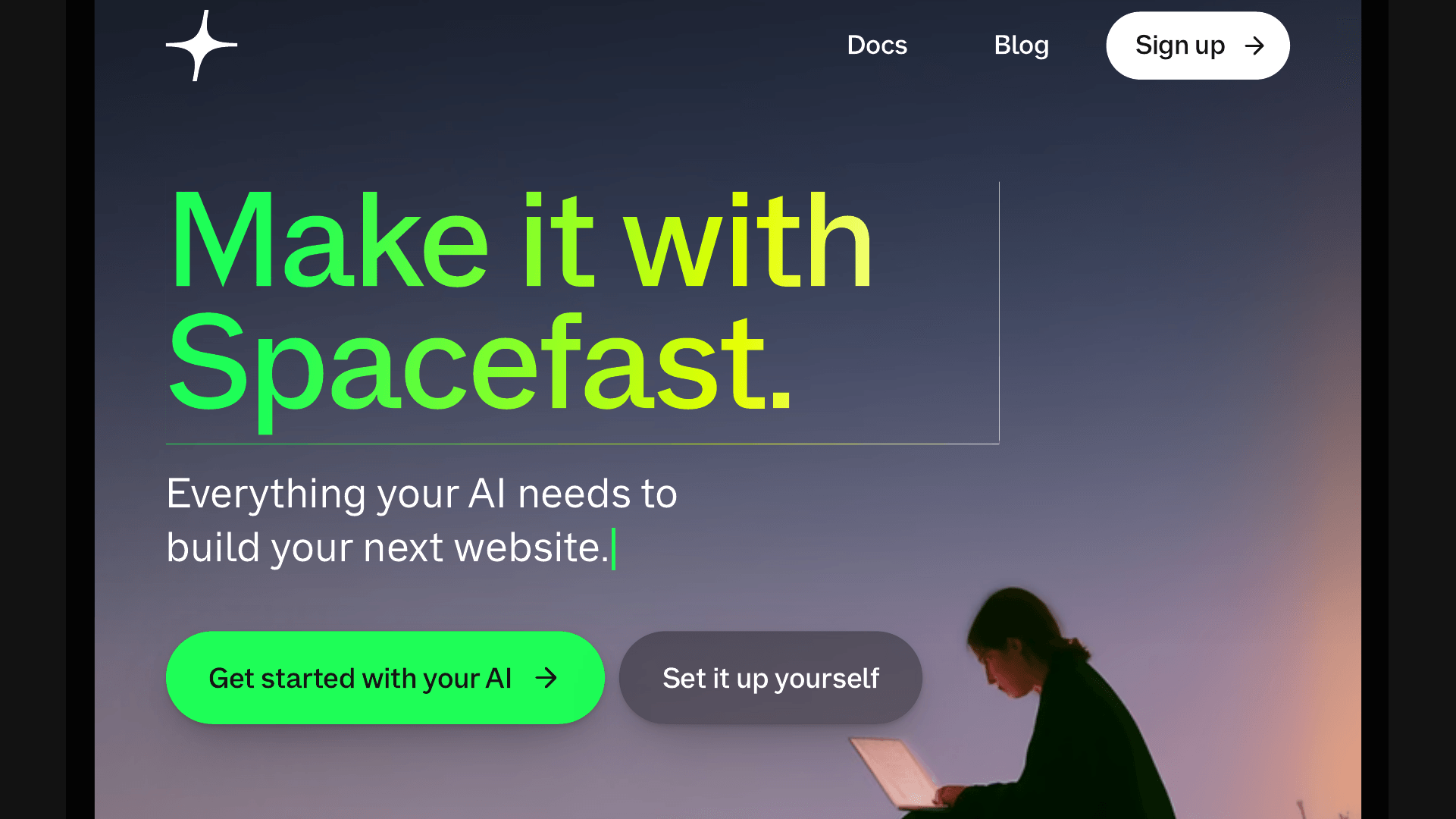
Spacefast is a hosting platform for apps built by AI. You build in Claude, ChatGPT, Cursor, or Codex, and Spacefast puts the result live in seconds, with version history, a database, and a custom domain. I published a test page with no account at all in 3.1 seconds, then signed up by email, no credit card, on the $0 Personal plan, and tested versioning, rollback, and the dashboard. The core promise held up: publishing is genuinely fast and simple. The rough edges are honest ones, an unclaimed Space expires in 33 hours and 20 minutes, and the ready database only appears for certain app types, not for a plain static page.
Spacefast launched publicly on 9 November 2026, from Automattic, the company behind WordPress.com. It was built by founder and CEO Batuhan Icoz during an internal hackathon. Here is what the free plan actually gives you, what it locks away, and what it costs when you outgrow it.
What Is Spacefast?
Spacefast is not an AI builder. It is the place an AI-built app lives after it is built. You publish from your coding agent through MCP or a plugin, by drag and drop, through Git, or through the CLI, and each project becomes a Space: private by default, with version history and rollback, file uploads, stats, custom domains, and, for Zero apps and Functions workers, a real MySQL database. It runs on WordPress.com infrastructure, which Automattic says serves more than 15 billion page views a month. The pitch is agent choice: keep whatever AI you already use, instead of paying for a bundled builder and its hosting together.
Spaces are private by default, shareable by link or password, and every publish is kept as a version you can preview and roll back to. Static sites can move to another host as they are, while apps on Spacefast runtimes need code changes to move, so portability depends on what you build.

Hands-On Test: How Spacefast Actually Performed
In line with our editorial testing policy, test one, publish with no account: I dropped a single index.html file, a one-page site for a fictional coffee shop called Bean and Bloom Coffee, with a menu, prices, and opening hours, onto drop.fast. It published as v1 in 3.1 seconds, live at coastal-sky.space.fast. Spaces are private by default, so the bare URL shows This space is private to anyone else, while the owner link renders the page. The dashboard warned Claim by Nov 14, 11:30 PM, which is 33 hours and 20 minutes after publishing, and the homepage FAQ confirms the rule: unclaimed Spaces expire 33 hours and 20 minutes after creation or the latest file-changing publish, capped at 30 days.
Test two, claim and dashboard: I signed up by email on 13 November 2026, no card, phone number, or ID check, and the account is code-based, with no password. Claiming the first Space failed, because the claim link lives in the original browser session and a browser switch lost it, so coastal-sky stays unclaimed and will be deleted after 14 November 2026, 11:30 PM unless claimed. That is partly an environment quirk, but it also shows the claim link is bearer-like: anyone with it can claim the Space, so it needs keeping private. I re-published the identical file while signed in, as kerned-haven.space.fast, in 7.3 seconds, owned by team An’s Team, with no expiry warning.
The dashboard on the Personal $0 plan showed $0.00 of $1.00 monthly credit, resetting 1 December 2026, with no payment method saved, and plan limits of 1 of 20 live Spaces, 0 of 20 custom domains, 1 of 100 builds today, 0 B of 477 MB storage, 1 of 1 team members, 7 days of activity history, and 48 hours of log history. Stats for 7 days showed 34 requests, with 11 visitor requests on 13 November.
Test three, versioning and rollback: I published the same file again as v2 in 6.3 seconds, then chose Roll back to v1, which created v3 from v1’s files, while v2 stayed available to roll back to. Every publish is kept and previewable, and permanent snapshot URLs survive renames and rollbacks. File uploads allow visitor and app uploads up to 5 MiB per file, with no HTML or executables, and 0 B was used. The domain kerned-haven.space.fast showed Live as primary, with Add domain available.
One important nuance: for this static HTML Space, no database was provisioned. The Database page says No database yet, and that publishing a Zero app or a Functions worker gives the Space a real MySQL database, on every plan. So the ready database is conditional on the app type, not automatic for a static page. Site settings showed Files mode off, SPA off, hide-from-search off, and private sharing with password, share links, and invites. Renaming keeps a 307 redirect. No watermark appeared anywhere, and nothing about the free plan asked for a card.

Free Plan vs. Real Pricing (And Hidden Limits)
The Personal plan is $0, no card required, with $1 of usage included every month, 20 Spaces and 20 custom domains, publishing from any agent, private by default, and commercial use. Usage credit resets monthly and does not roll over, and the free plan never charges for more. Paid-plan usage credit is shared across a team, resets monthly, and does not roll over either, with overages added to the next monthly bill.
| Plan | Monthly price | Usage included | Spaces and domains |
|---|---|---|---|
| Personal | $0 | $1 a month | 20 Spaces, 20 custom domains |
| Go | $5 | $5 a month | 100 Spaces, 100 custom domains |
| Pro | $15 | $15 a month | 500 Spaces, 500 custom domains, 5 members free |
| Enterprise | Custom | Custom | SSO, subteams, log drains, SLA |
Go adds hourly database backups, a datacenter choice, and email support. Pro adds team roles, wildcard domains, and priority email support. Boost costs $9 per Space a month on Go and up, raising one Space to 8 compute workers, burst 16, 50 GB disk, and 2 GB memory per request, and is not available on Personal. One naming wrinkle: Space Settings describes Boost as Requires Go or Plus, a Plus tier name that does not appear on the public pricing page. Billing is monthly in USD before tax, upgrades are prorated, downgrades apply at renewal, and spending caps on Go and Pro start at twice the plan price with alerts at 50, 75, and 100 percent, while deployed Spaces keep serving at the limit. No promo code was found on the homepage or pricing page. The only reader perk is a referral link in Billing: 1 more friend unlocks 30 Spaces.

Pros
- Live in seconds, no account: a static page published in 3.1 seconds with no sign-up and no card.
- Generous free plan: $0, $1 of usage a month, 20 Spaces, 20 custom domains, commercial use allowed.
- Versioning that works: every publish is kept, previewable, and rollback created v3 from v1 cleanly.
- Private by default: Spaces stay hidden until you share them, with password and share links.
- Agent-agnostic: publish from Claude, ChatGPT, Cursor, Codex, Git, drag and drop, or CLI, with no double AI spend.
Cons
- Database is conditional: a static page gets no database; only Zero apps and Functions workers do.
- Unclaimed Spaces expire fast: 33 hours and 20 minutes unless claimed, capped at 30 days.
- Claim link is bearer-like: anyone with the link can claim the Space, and losing it strands the Space.
- Early product gaps: app authentication, transactional email, and shared team knowledge were still in beta at launch.
- Thin independent feedback: 0 scored reviews on G2, Trustpilot, and Capterra, and one detailed hands-on test so far.
What Real Users Are Saying
Spacefast is 4 days past its public launch, so there are almost no independent customer reviews yet: 0 scored reviews on G2, Trustpilot, and Capterra, 110 Product Hunt upvotes and 11 comments at number 6, and no verified Reddit discussion thread. Do not confuse it with Spacest.com, a different apartment rental company with its own Trustpilot page. The most useful evidence is the one detailed independent hands-on test, by Casey Burridge, Head of Marketing at GravityKit, who let Claude Code build a live WordPress AI-plugin tracker in about 15 minutes, with no code written by him and no server set up. He praised the speed and the private-by-default versioning, but reported a painful agent onboarding, with a setup link that expired in about 15 minutes, a cron scheduler that seemed broken, with each run getting about 5 seconds, and docs that contradicted the generated template. Automattic’s launch post and TechCrunch coverage position it against Lovable and Emergent, with Vercel as the comparison users already know. Founder Batuhan Icoz told TechCrunch he expects people to churn, and that the product has to make building with Spacefast clearly easier and better.
Who Should Use Spacefast (And Who Should Skip It)
Use it if you build with an AI coding agent and want the result live in seconds without learning a new builder or paying for AI twice. The free plan is genuinely usable for side projects, demos, and client previews, with 20 Spaces and commercial use. Skip it if you need a managed database on a static site, built-in app authentication today, or a host you can leave without code changes for a runtime app. Teams that need long-running scheduled jobs should also check the cron limits first, since the one hands-on test found them short and unreliable.
Whacka Review
If you want instant static website hosting and simple landing page deployment, see our Whacka review.
Frequently Asked Questions
Is Spacefast really free?
Yes, the Personal plan is $0 with $1 of usage included every month, 20 Spaces and 20 custom domains, and no credit card required. I published my first page with no account at all.
Does Spacefast add a watermark on the free plan?
No. No watermark appeared on the published test page or in the dashboard, and nothing in the pricing suggests one.
How much does Spacefast cost per month?
Personal is $0, Go is $5 a month, Pro is $15 a month, and Enterprise is custom. Boost costs $9 per Space a month on Go and up.
Can you use Spacefast creations commercially?
Yes. Every plan allows commercial use, including the free Personal plan, according to the official pricing page.