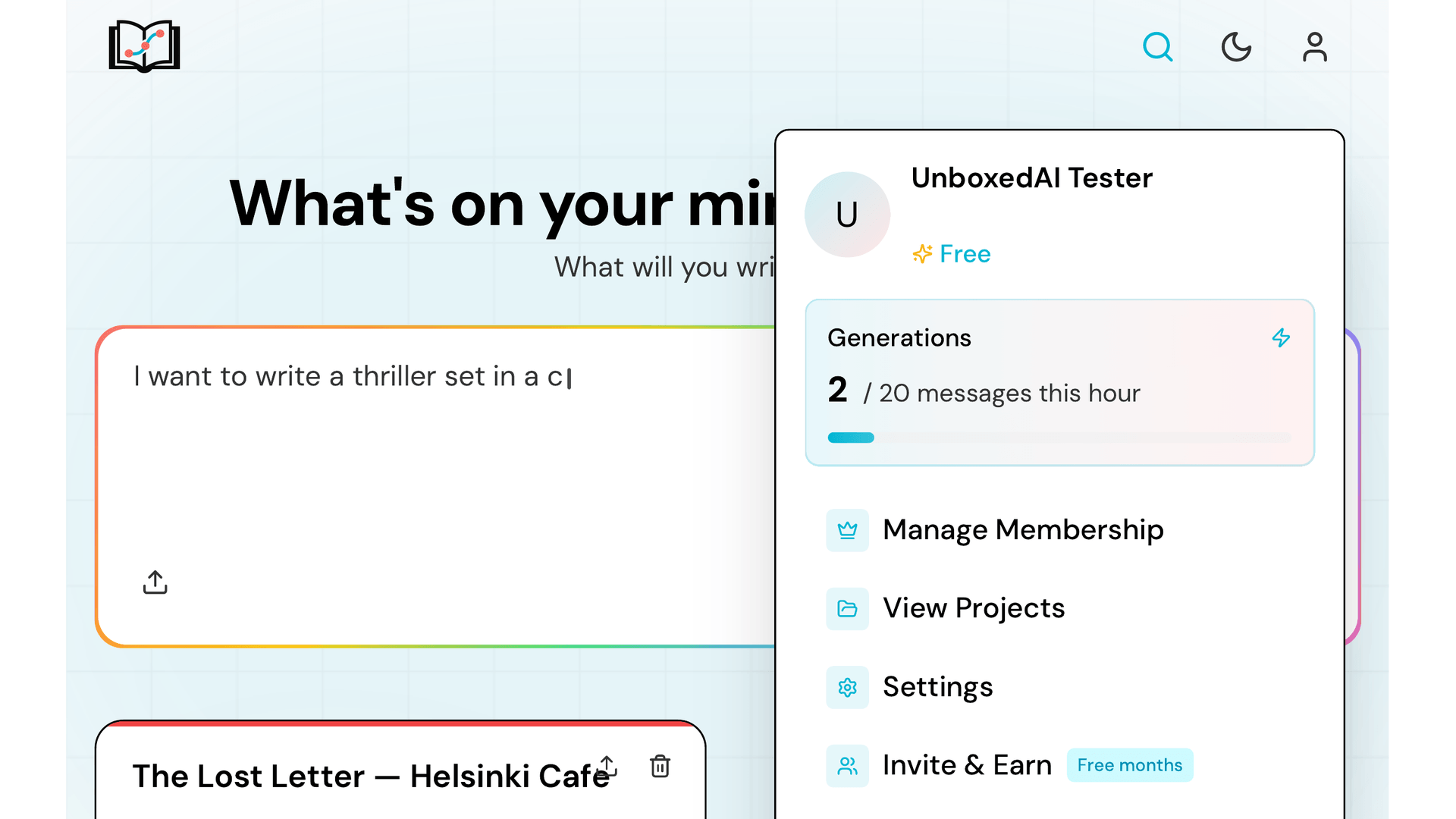
I write fiction in my spare time, so a tool that promises to remember my whole story sounded like exactly the help I need. I tested Narratex on the free Draft plan with a short story about a Helsinki cafe owner who finds a lost 1968 letter, and the memory test is the reason this review is positive. The AI answered a question about my chapter correctly on every checkable fact, then wrote a continuation in the same voice and gave me criticism sharp enough to use. Narratex earns 7.0/10 from me, Worth trying. The free plan is genuinely usable, with 20 assistant messages an hour, but the usage counter lags, and the free export rules contradict what the app itself offers.
Narratex is an AI writing workspace for long-form fiction. It combines a Story Blueprint, a full editor and an AI collaborator that share one memory of your manuscript, so you never re-explain who your characters are. It is built by Khanh Tran, a UX designer in Washington, DC, who writes fiction on the side. It runs on Claude Sonnet and Haiku, the AI is included in every plan, and there are no credits to ration and no API keys to set up. It has been in open beta since 2026, and it has 0 independent reviews anywhere I could find.
What Is Narratex?
Narratex is for novelists and short story writers who lose track of their own cast. You set up a Story Blueprint with characters, settings and plot threads, write chapters in the editor, and the assistant reads your chapter summaries before it answers, so it knows what happened in chapter twelve because it read chapter twelve. You can import a finished draft and it splits it into chapters, detects the structure, extracts characters and plot threads, and writes chapter summaries. The Writer plan keeps prose generation off by design for writers who want to write every word themselves, while the Author plan turns the full writing partner on. The free Draft plan gives you 1 project and 5 chapters, plain text export with a watermark, and 20 assistant messages an hour.
Hands-On Test: How Narratex Actually Performed
In line with our editorial testing policy, I signed up with an email address, no card, and created a project called “The Lost Letter – Helsinki Cafe”, a short story with a 5,000-word goal. The app auto-created Chapter 1 and a 3-act outline. I filled in the Blueprint myself: Aino Korhonen, the protagonist, Eero Laine, the man the letter was addressed to, the Kahvila Aamu cafe as the setting, and “The Undelivered Letter” as the plot thread. The Story Foundation meter rose from 20 percent to 80 percent as I added each piece. One catch: the AI claimed it had analyzed my content and extracted all the key story elements, but the Blueprint actually showed no characters created yet.

Then I wrote a 245-word opening chapter in the editor, about Aino unlocking the cafe on a rainy Kallio morning and finding the unsealed letter behind the old radiator. The editor would not accept pasted text, so I typed it key by key. Then came the memory test. I asked the AI for the cafe owner’s name, the cafe, the location, what the letter contains, who it was addressed to and when it was written. It got every checkable fact right: Aino Korhonen, 38, Kahvila Aamu on a quiet street in Kallio, the letter addressed to Eero Laine at Mannerheimintie 14, postmark 12 March 1968, a confession of love signed only “S”. Two slips: it said the letter was written on the postmark date, which my chapter never states, and it pulled in Vilho the retired postman, who exists only in my original story idea, not in the chapter.

I asked it to continue the chapter, and in under a minute it gave me a short craft critique first, then about 130 words of Suggested Prose in the same voice and tense, with Vilho arriving at the door and Aino saying she found something. Then I ran Analyze Project, which took 2 minutes 36 seconds and returned a full Editor’s Letter. It praised the letter as the inciting object and the atmosphere, then told me the chapter “reads like a prologue that thinks it is a first chapter” and that “Aino is a camera, not a character”. That stung a little, and it was right. One confusing point: the analysis said Vilho appears in the character list, which I never added. A later check showed the analysis run had itself enriched the Blueprint, lifting Story Foundation to 95 percent and adding Vilho, “S”, 7 worldbuilding items and 2 themes without further input. The tool’s own automation created the fact it then cited. The usage counter has a lag of its own: it read 0/20 after two AI messages and one analysis, and only showed 2/20 after a page reload.
Free Plan vs. Real Pricing (And Hidden Limits)
Pricing is flat and monthly, with no credits to ration. The Draft plan is free forever: 1 project, 5 chapters, plain text export with a watermark, 7 days of version history, and 20 assistant messages an hour. Every paid plan starts with a 7-day free trial, and annual billing saves about 17 percent.
| Plan | Monthly | Yearly | What you get |
|---|---|---|---|
| Draft | $0 | $0 | 1 project, 5 chapters, plain text export with watermark |
| Writer | $8 | $79 a year | Unlimited projects and chapters, DOCX, PDF and EPUB export, prose generation off by design |
| Author | $19 | $190 a year | Full writing partner at 60 messages an hour, inline editing, unlimited chapter summaries |
| Series | $49 | $490 a year | Everything unlocked, 120 messages an hour, unlimited imports and analysis |
Two conflicts are worth flagging. First, the pricing table says Draft export is plain text only with a watermark, but the in-app menu offered PDF and DOC export on the free plan, and no exported file came through to check the watermark. Second, the FAQ says the Writer plan has Prose Generation Tools, but the comparison table shows Writer with no writing partner and no inline editing, while Draft has 20 messages an hour. There is no promo code. I checked the homepage, the pricing page and the BetaList listing, and the only savings are annual billing and the trial. The multi-book universe on the Series plan is marked coming soon rather than shipped.

Pros
- Story memory that works: the AI answered my memory question correctly on every checkable fact, from the cafe name to the 12 March 1968 postmark
- Criticism sharp enough to use: the project analysis called my chapter a prologue that thinks it is a first chapter, and it was right
- Continuation in the same voice: about 130 words of Suggested Prose that kept the tense, the tone and the thread
- Honest free plan: 1 project, 5 chapters and 20 assistant messages an hour, no card, no credits to ration
- Your writing is never used to train AI models: stated on the pricing page, with no API keys to set up
Cons
- Usage counter lags: it read 0/20 after two AI messages and an analysis, and only showed 2/20 after a reload
- Export rules contradict themselves: the pricing table says plain text with a watermark, the app menu offered PDF and DOC, and no file came through to verify
- It draws on your premise, not just your chapter: Vilho came from my story idea, not the chapter, and the analysis cited a character its own enrichment had added
- Prose generation gap: Narratex itself concedes Sudowrite is the more direct answer if you want it to draft passages in your voice
- No model choice: the AI is the one Narratex picked, and there is no way to point it at a provider you prefer
What Real Users Are Saying
There is nothing to quote here, and I want to be plain about that. Narratex has 0 independent reviews on G2, Trustpilot, Capterra, Reddit, Product Hunt, FutureTools, X, Instagram, Facebook and Threads, as far as I could verify. Search results for the name mostly return a different product, narratex.space, a text-to-speech tool, which has nothing to do with this review. What follows is vendor-stated, not user feedback: Narratex says the Blueprint, the editor and the assistant share one memory of your manuscript, that flat pricing includes the AI with no second bill, and that the Writer plan keeps prose generation off by design. Its own comparison pages concede that Sudowrite has the longer track record and far more third-party coverage, and that NovelCrafter has the larger community. Until real users show up, the honest summary is that the memory and the criticism worked for me in a real test, with small slips around the edges.
Who Should Use Narratex (And Who Should Skip It)
Use Narratex if you write fiction and lose track of your cast, your timelines or your own plot threads, and you want an assistant that has actually read your chapters before it answers. The free Draft plan is enough to test that properly on one story. Skip it if you want an AI to draft passages in your voice, since that is the honest gap Narratex itself names, and Sudowrite is the more direct answer there. NovelCrafter is the alternative if you want to choose your own model and bring your own API key, though you then pay the provider on top. If you write non-fiction, the story memory still works, but the Blueprint is built for characters and plot, so a general writing tool may fit better.
AxiomStory Review
If you are looking for long-form creative fiction writing and worldbuilding assistants, explore our AxiomStory review.
Frequently Asked Questions
Is Narratex really free?
Yes. The Draft plan is free forever, with 1 project, 5 chapters, the full editor and Story Blueprint, plain text export with a watermark, and 20 assistant messages an hour. No card is required.
Does Narratex add a watermark on the free plan?
The pricing table says Draft export is plain text with a watermark, but the in-app menu offered PDF and DOC export on the free plan, and no exported file came through to check. The watermark could not be visually verified in my test.
How much does Narratex cost per month?
Paid plans are Writer at $8 a month, Author at $19 a month and Series at $49 a month, with annual billing saving about 17 percent. Every paid plan starts with a 7-day free trial.
Can you use Narratex creations commercially?
Yes. Your writing stays yours, it is never used to train AI models, and content remains exportable after a downgrade, though extra features become read-only.