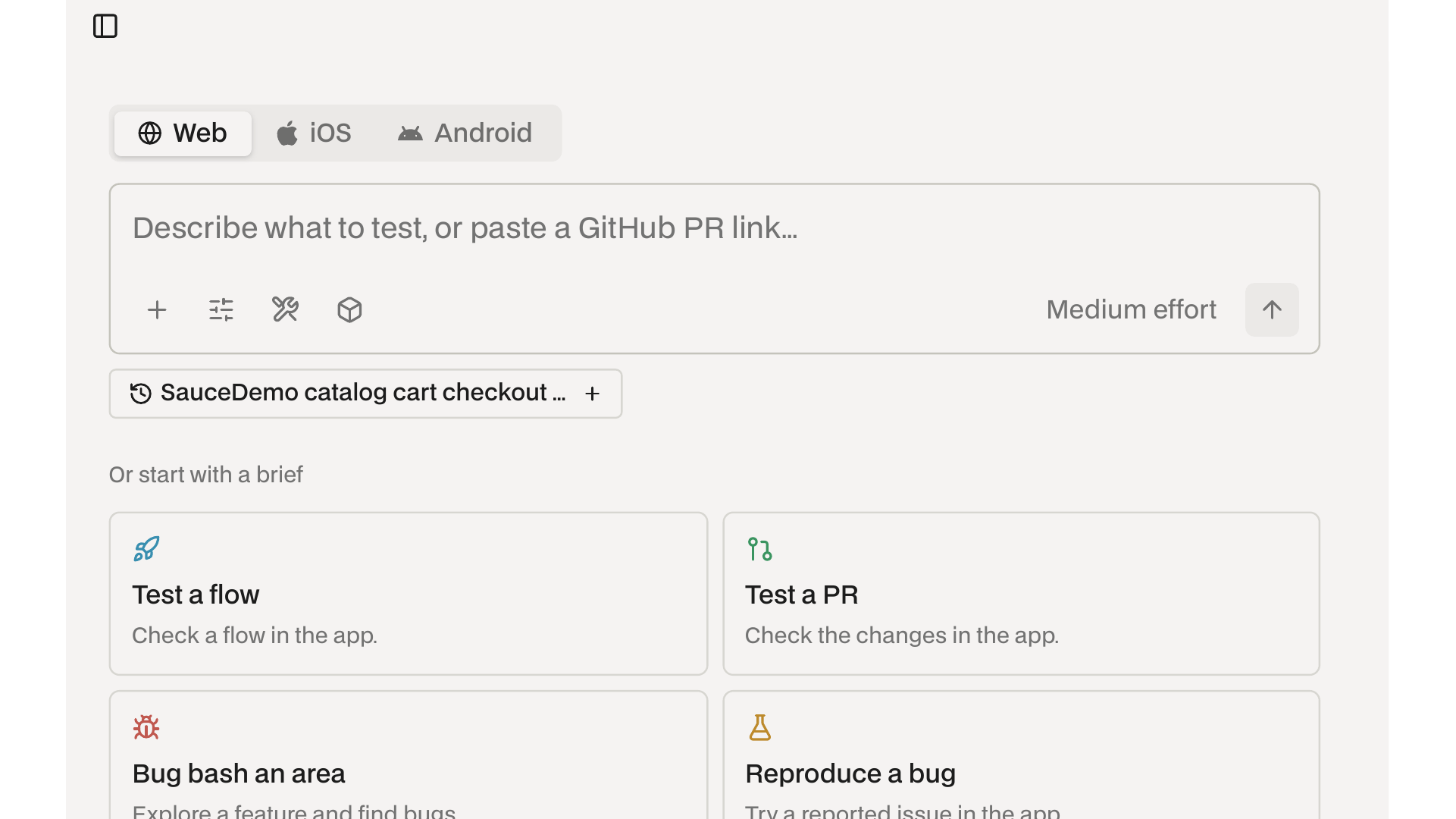
Momentic is an AI QA engineer called Mo. You point it at a web app, describe what should work, and it explores the app like a user, then reports the bugs it reproduced, with steps and a video replay for each one. I signed up by email, no credit card required, and got $50 of free usage a month. Then I set Mo loose on a public demo store for about 17 minutes. It ran 69 test cases and found 8 real bugs for $7.35, including an empty cart that can be checked out as a dispatched order. That is a genuinely useful free plan, and the findings were good enough to act on. It is not cheap per session, though, and the jump from free to the $500 a month Scale plan is steep.
Mo launched publicly on 2 November 2026, on Hacker News, from Momentic, a YC W24 startup founded in late 2023. Here is what the free plan actually does, what one bug bash cost, and what it locks away behind paid plans.
What Is Momentic?
Momentic is an autonomous QA agent. Instead of writing test scripts, you describe a flow in plain English, or paste a GitHub pull request link, and Mo plans test cases, drives the app in parallel browsers or on real iOS and Android devices, and reports what breaks. It also does PR testing for Vercel and Cloudflare deploy previews, writes end to end tests in YAML that live in your repo, and re-runs them as regression tests, healing them when the UI shifts. The company says Mo found 269 of 1,396 labelled bugs at 84 percent precision in its own QA Bench, against 86 for Codex and 59 for Claude Code. That is a vendor benchmark, not an independent one, so I treated it as a claim to check, not a fact.
Mo is aimed at teams that ship web and mobile apps and want a QA engineer on demand. The free plan covers individuals and small projects, with all core features and AI test authoring included.

Hands-On Test: How Momentic Actually Performed
In line with our editorial testing policy, I signed up by email on 13 November 2026 with no card, phone number, or ID check. The app showed Usage 0 percent, $0.00 of $50.00, Free plan, period 13 November to 13 December 2026. That matches the public pricing page exactly.
For the main test I asked Mo to bug bash the product catalog, cart, and checkout flow on SauceDemo, a public demo e-commerce app, using the demo store’s standard test login, at Medium effort, on Web. The session started at 12:07 UTC and completed at 12:24 UTC, about 17 and a half minutes, with 5 agents and 69 test cases. Mo’s summary: 6 functional bugs and 2 catalog issues. Sorting, product links, cart synchronisation and persistence, checkout totals, and ordinary receipt contents all passed.
The 8 findings, all marked Needs review, were:
- Medium: an empty cart can be checked out as a dispatched order.
- Medium: required checkout fields accept whitespace-only values.
- Low: the Bolt T-Shirt photo contradicts its red bolt description.
- Low: reloading checkout completion removes the order receipt download.
- Low: the Onesie description says hemmed sleeved instead of sleeves, a typo.
- Low: pressing Enter in checkout information cancels instead of continuing.
- Low: returning from checkout overview clears submitted customer information.
- Low: the order PDF corrupts Japanese customer names.
The evidence behind each bug is real and usable. The empty cart bug shows Expected versus Actual, 3 numbered repro steps, and a 0:37 bug-replay video with 9 timestamped steps, viewport 1920 by 1080, with playback controls, marked Verified through video analysis. It even logged a GET inventory.html 404 at 0:01. One honest caveat: the replay is per bug, not a full session recording. The session pane says no screen recording is available for the session as a whole.
The session cost $7.35, leaving $42.65 of the $50. Billing shows Mo $7.35, Test execution $0, Agents $0, on invoice WMZAHU-00001 for $0.00, marked Paid. Mo’s own estimate was $7.30, split as Mo usage $3.65, web-browser usage $2.50, and browser setup $0.85 plus $0.30, with the page noting estimates may differ from billed usage. One thing to know: the usage meter lags. It showed $0.00 and 0 percent throughout the run, rose to $6.02 just after completion, then settled at $7.35. Do not trust the live counter while a session is running.
No watermark appeared on the bug replay or the demo store frames. Export to Linear and Export to Jira buttons are present in the bugs list, but I did not test them, as no Linear or Jira integration was connected, and no export limit was encountered. I also checked what is locked: SSO is Enterprise-only, and phone numbers for SMS and OTP testing are not self-serve, the app says to contact the Momentic team to provision one.

Free Plan vs. Real Pricing (And Hidden Limits)
The free plan is $0 a month with $50 of usage each month, all core features, AI test authoring, 30-day results retention, and no credit card required. Usage does not roll over, and runs pause at $0 with no overages. The Launch HN post said every new signup gets $250 in Mo spend, and the YC page still says $250 in free credits on signup, but I found no $250 offer anywhere: not on the home page, the pricing page, sign-up, onboarding, billing, the usage page, or the verification email. Only the $50 free usage was ever offered, so treat the $250 as an unverified launch claim, not the current free tier.
| Plan | Monthly price | Usage included | Key limits |
|---|---|---|---|
| Free | $0 | $50 a month | 30-day retention, no card, SSO and phone numbers not included |
| Scale | $500 | $500 a month | Add funds from $50, 5 Android plus 5 iOS devices, 5 phone numbers, shared Slack |
| Enterprise | Custom | Test-based pricing | SAML SSO, SCIM, audit log, 1-hour mobile sessions, priority support |
Published per-step rates for test execution are $0.0125 per test step, $0.025 per AI-generated or failure-recovery step, and $0.005 per minute of hosted browser, with Android at $0.10 a minute and iOS at $0.1875 a minute. My Mo session was billed as Mo usage, with no per-step breakdown shown, so those rates did not map directly onto the $7.35. At that burn rate, the $50 free tier covers about 6 bug bashes like mine a month. The gap between Free and Scale is the real pricing story: there is no middle tier, so a team that outgrows $50 a month jumps straight to $500.

Pros
- Real bugs, real evidence: 8 findings in one session, each with repro steps and a video replay.
- Generous free tier: $50 of usage a month, no card, enough for about 6 bug bashes like mine.
- No test scripts to write: plain-English briefs, tests stored as YAML in the repo, self-healing runs.
- Fast to a result: 69 test cases across catalog, cart, and checkout in about 17 minutes.
- Honest billing record: a $0.00 paid invoice, runs pause at $0, no overages on free.
Cons
- Pricey per session: $7.35 for one 17-minute bug bash, and Mo costs more per bug than Codex by its own numbers.
- Steep paid jump: no tier between Free at $50 of usage and Scale at $500 a month.
- Usage meter lags: it showed $0.00 throughout the run and only settled at $7.35 after completion.
- No full session recording: replays exist per bug only, not for the session as a whole.
- Launch credit confusion: the $250 signup offer on HN and YC never appeared anywhere in the product.
What Real Users Are Saying
There are no scored reviews of Momentic on G2, Trustpilot, or Capterra yet, and no Product Hunt launch for Mo. The real discussion is the Launch HN thread, with 167 points and 146 comments. The praise there is for finding far more bugs than general coding agents, and for needing no test scripts. The pushback is about cost: by the founders’ own numbers Mo costs $2.67 per confirmed bug at 84 percent precision, against $0.80 at 86 percent for Codex, and several commenters asked why they would not just run Claude Code against their own Playwright harness. Co-founder Jeff An confirmed in replies that Mo is inherently non-deterministic, and that its regression-test YAML format is proprietary, readable only by Momentic’s own CLI. One independent hands-on test, VibeToolRank on 5 November 2026, scored it 9.6 out of 10 across 3 runs, and caught a seeded pricing bug in 3 of 3 tunnel sessions. The homepage carries vendor testimonials from Notion, GPTZero, Runway, Webflow, and Quora, which are vendor-published, not independent reviews.
Who Should Use Momentic (And Who Should Skip It)
Use it if you ship a web app and want a QA pass without hiring a tester or writing a test suite. The free $50 a month is enough to bug bash a staging build a few times a month, and the video replays make the findings easy to hand to a developer. Skip it if your testing budget is tight and your flows are already covered by a Playwright suite, or if you need deterministic, scripted regression tests you fully own. Teams that outgrow the free tier should price the $500 Scale plan carefully, since there is no step between the two.
Clocked Review
If you are evaluating automated testing tools for developer software workflows, compare how Clocked approaches agent capabilities.
Frequently Asked Questions
Is Momentic really free?
Yes, the Free plan is $0 a month with $50 of usage each month and no credit card required. My test used $7.35 of that allowance, and runs pause at $0 with no overages.
Does Momentic add a watermark on the free plan?
No. No watermark appeared on the bug replays or the tested app frames in my session, and nothing in the pricing suggests one.
How much does Momentic cost per month?
Free is $0 with $50 of usage a month. Scale is $500 a month with $500 of usage included, and Enterprise is custom, test-based pricing. There is no tier between Free and Scale.
Can you use Momentic findings commercially?
Yes. Momentic’s Terms say the customer owns its data, and Mo’s bug reports, repro steps, and replays are your test output to use in your own development workflow.