I signed up for Clocked with a temp email, no card, and started with exactly 4,000 free credits. I redeemed the challenge promo code CLOCKEDHACKATHON on the Account page and it added 16,000 more, even though the Build Challenge had closed two days earlier. I then ran three live API tests in the playground, Decide, Extract, and Protect, in under a second each, for 23 credits in total. The results were fast, cheap, and mostly accurate, with two clear misses worth knowing about before you build on it.
Clocked by Rezolve.ai launched its Build Challenge on 21 October 2026, and I found no independent customer reviews for it anywhere as of 12 November 2026. That is the point of this review: a brand new developer API, tested on its free tier, with exact credit counts and timings, so you can judge it before you pay.
What Is Clocked?
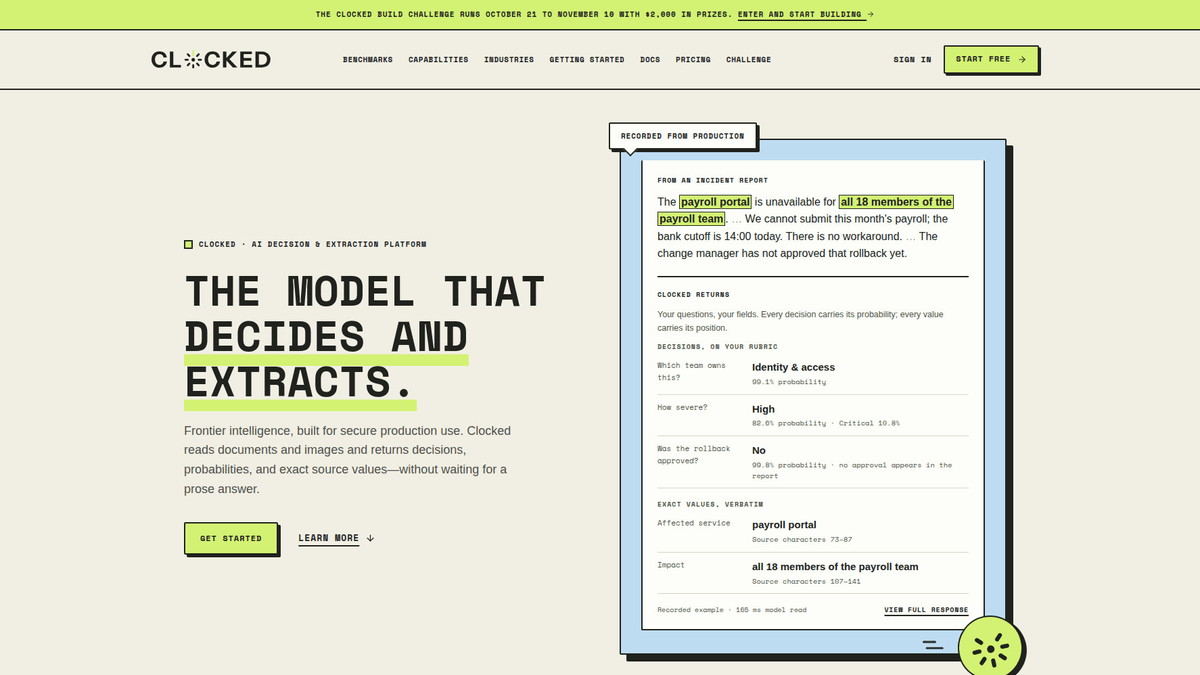
Clocked is an API that brings language model understanding to software through structured outputs instead of open-ended chat text. You pay per 25 ms of model time, rounded up per request, rather than per token.
Its nine endpoints are organized into three groups:
- Decide, Extract, and Fill: Makes routing decisions with probabilities, extracts exact fields with source positions, and fills structured inputs.
- Protect, Guard, and Inspect: Masks personal data with placeholders and checks safety rules.
- Verify, Compare, and Rerank: Checks factual consistency and orders results.
The maker, Rezolve.ai, ran the Clocked Build Challenge from 21 October to 10 November 2026, with $2,000 in cash prizes: $600 Best Overall, $400 for each of the three endpoint groups, and $200 People’s Choice. Entries closed on 10 November at 11:59 p.m. ET, judging runs 11 to 17 November, and winners are announced on 18 November. The challenge post promised 4,000 free credits at sign-up plus 16,000 more with the code CLOCKEDHACKATHON, for 20,000 in total and 4 concurrent requests. My test on 12 November 2026 checked whether that code still worked after the challenge closed.

Hands-On Test: How Clocked Actually Performed
In line with our editorial testing policy, I signed up on 12 November 2026 using email verification. No credit card, phone number, or ID check was asked for at any point. My starting balance was 4,000 free credits (worth $0.80 at Production rates) with no expiration date, and redeeming the CLOCKEDHACKATHON code on the Account page immediately added another 16,000 credits for 20,000 credits total.
Test 1 was Decide. My input was a checkout page returning a 500 error for about 20 percent of EU customers since 09:00, with no workaround and an emergency rollback approved by the support lead. It ran in 597 ms for 2 credits, and the balance fell from 20,000 to 19,998 after the promo redemption. The result approved Yes at 98.7 percent, with No at 1.3 percent and a 75 percent cutoff. It routed the issue to “network” at 62.4 percent, against hardware at 18.3 percent and identity at 19.3 percent, and flagged the spread confidence of 43.6 percent as low confidence. That routing is a config limitation as much as a model miss: the route list had no payments or checkout option, so a checkout 500 had nowhere better to go.
Test 2 was Extract. My first run used the wrong field set, an IT ticket set against an invoice text, and it matched only the email address, with every other field honestly shown as “Not stated”. That run took 425 ms for 8 credits. I re-ran it with matching corrected invoice fields, and it took 353 ms for 5 credits. The input was invoice INV-2026-1147 from Meridian Office Supplies Ltd to Northgate Retail Group, dated 9 November 2026, with a total of $4,820.50 and an 11 November correction to $4,720.50, due 30 November 2026. Extract picked the corrected total, $4,720.50, and left the absent fields, PO, subtotal, tax, payment status, and bank details, honestly as “Not stated”. The balance fell to 19,985 after this run.
Test 3 was Protect, PII masking. My input was a fictional support note with a name, email, phone, address, date of birth, passport, and employee ID EMP-7741. It ran in 397 ms for 8 credits, and the balance fell to 19,977. It found 6 items, all at 100.0 percent confidence, person, email, phone, address, date of birth, and passport, and transformed them to placeholders: <PERSON>, <EMAIL>, <PHONE>, <ADDRESS>, <DATE_OF_BIRTH>, and <PASSPORT>. The miss matters: employee ID EMP-7741 was not detected at all. Custom identifiers need the separate custom identifiers example, so a plain employee ID is not covered by the default set.
My ending balance was 19,977 of 20,000, so all three tests, plus the first Extract run, cost 23 credits in total, about $0.0046 at Production rates. Every test ran in under 1 second. Six of the nine endpoints, Fill, Guard, Inspect, Verify, Compare, and Rerank, were not tested, and I did not create an API key, so this review covers the playground only, not a live integration.

Free Plan vs. Real Pricing (And Hidden Limits)
The free plan is a Free Trial at $0, with 4,000 credits once, a shared model, 1 concurrent request, all 9 endpoints, and 3 months of support. The promo code CLOCKEDHACKATHON, redeemed on the Account page on 12 November 2026, added 16,000 credits and raised the limit to 4 concurrent requests, for 20,000 in total. One code per account. The code still redeemed two days after the challenge closed on 10 November 2026, so treat it as a leftover that worked on the test date, not as a live launch offer. Included credits reset monthly, with no rollover, and overage stays off until you enable it and set a limit.
Paid plans, checked on the official pricing page on 12 November 2026, in USD with tax excluded:
| Plan | Monthly billing | Annual billing | Included credits a month |
|---|---|---|---|
| Free Trial | $0 | $0 | 4,000 once |
| Build | $29 a month | $26.10 a month, $313.20 a year | 120,000 |
| Production | $249 a month | $224.10 a month, $2,689.20 a year | 1,250,000 |
| Scale | $999 a month | $899.10 a month, $10,789.20 a year | 6,500,000 |
| Dedicated H200 | From $7,500 a month | Not stated | Not stated |
| Dedicated B200 | From $10,000 a month | Not stated | Not stated |
Annual billing is 10 percent off and adds 10 percent more credits. Overage on Build is $0.30 per 1,000 credits, on Production $0.25, and on Scale $0.20. Paid tiers add private feedback loops, dedicated models, custom extraction fields, larger guard value sets, third party tooling such as Zapier, n8n, Make, and MCP, and dedicated hosting. Cancelling means service ends at the period end, charges are final, and there are no refunds on previous purchases.
I checked for promos on the pricing page and the challenge pages, and CLOCKEDHACKATHON is the only official code found. No other promo code, launch discount, or student deal appeared. I did not use third party coupon sites, and I am not inventing a code.
Terms flag: the Service information page gives no uptime SLA, no guaranteed support response, no version pinning, and no minimum deprecation notice. The Security and data page says stored response bodies are cleared only by scheduled maintenance, not on a hard 24 hour deletion guarantee, and Protect returns the original entity values alongside the masked copy, so do not treat the masked output as the only copy. There is no standalone Terms of Service page linked in the site footer, only Security and data, Service information, and Changelog. Agree the region, subprocessors, and deletion terms in writing before enterprise use.

Pros
- Fast and cheap in the playground: all three tests ran in under 1 second, and Decide, Extract, and Protect together cost 23 credits, about $0.0046 at Production rates.
- Generous free start, with the code: 4,000 credits at sign-up, plus 16,000 more from CLOCKEDHACKATHON, which still redeemed on 12 November 2026 after the challenge closed.
- Honest structured output: Extract picked the corrected invoice total of $4,720.50 and left absent fields as “Not stated” instead of guessing them.
- Clear per call pricing: 1 credit covers up to 25 ms of model time, with the cost, time, and balance shown on every playground run.
Cons
- Only 3 of 9 endpoints tested: Fill, Guard, Inspect, Verify, Compare, and Rerank were not run, and no API key was created, so a live integration is untested.
- Protect missed a real identifier: employee ID EMP-7741 was not detected, while the other 6 PII items were found at 100 percent confidence.
- Decide routing needs your config: a checkout 500 was routed to “network” at 62.4 percent with low confidence flagged, because the route list had no payments or checkout option.
- No customer record yet: 0 independent reviews were found, and the terms give no uptime SLA, no version pinning, and no hard deletion guarantee for stored response bodies.
What Real Users Are Saying
I have to be direct here: I found no independent customer reviews for Clocked itself. I checked Product Hunt, Trustpilot, G2, Reddit, DEV, LinkedIn, and Medium, and none of them returned a verified user review. There is no G2 or Trustpilot profile for Clocked, and no Product Hunt review rating to cite. The parent company Rezolve.ai has a Slashdot listing, but it carries no usable Clocked specific reviews. Rezolve.ai itself does have G2 reviews, 4.8 out of 5 from 38 reviews, but those are for its service desk product, not for Clocked, so I am not counting them here.
What exists instead is challenge material. One independent DEV write-up of a challenge entry, ScopeShield, dated 11 November 2026, reports Clocked returning probabilities and structured results that a small app could turn into a queue, with 46 credits across 22 calls for a sample analysis and 120 credits for a 33 case evaluation. The official challenge post on LinkedIn drew 7 reactions and one comment, “Go build something cool!”, and the Clocked LinkedIn page has 57 followers. None of this is paying customer evidence, so I am not presenting it as such. I also found no billing, credit, or cancellation complaints anywhere, but that only reflects the absence of reviews, not satisfied users.
Who Should Use Clocked (And Who Should Skip It)
Use Clocked if you are a developer who needs decisions, extractions, or PII masking as structured data with probabilities, you want to prototype in a playground before wiring up an API key, and you like paying per millisecond of model time instead of per token. The free 4,000 credits, and the 20,000 total if the code still redeems, cover a lot of testing for nothing. Skip it if you need a proven customer record, a contractual uptime SLA, or version pinning before you put it in production, because none of those exist yet. Skip it too if your main need is one of the six endpoints I did not test, Fill, Guard, Inspect, Verify, Compare, or Rerank, until someone has run those live. And if you need PII masking for custom identifiers such as employee IDs, test that exact identifier first, because the default set missed one in my test.
Coderblock AI Review
If you are building complete browser applications with persistent storage instead of test suites, see our Coderblock AI review.
Frequently Asked Questions
Is Clocked really free?
Yes, the Free Trial costs $0 with no card, and it gives 4,000 credits once, with all 9 endpoints and 1 concurrent request. On 12 November 2026 the promo code CLOCKEDHACKATHON added 16,000 more credits and 4 concurrent requests, for 20,000 in total, even though the challenge had closed on 10 November.
Does Clocked add a watermark on the free plan?
No. Clocked is an API, not an image tool, so there is no watermark. Outputs are structured JSON with probabilities and source positions. Note that Protect returns the original entity values alongside the masked copy, so the masked output is not the only copy.
How much does Clocked cost per month?
Paid plans start at Build $29 a month, or $26.10 a month billed annually, with 120,000 credits a month. Production is $249 a month, or $224.10 annually, with 1,250,000 credits a month. Scale is $999 a month, or $899.10 annually, with 6,500,000 credits a month. Dedicated hosting starts at $7,500 a month for H200 and $10,000 a month for B200. Prices are in USD with tax excluded.
Can you use Clocked commercially?
The free trial is for testing, and paid plans are the commercial route, but Clocked publishes no standalone Terms of Service page in its footer, and its Service information page gives no uptime SLA or version pinning. Check the Security and data page and agree the region, subprocessors, and deletion terms in writing before enterprise use.