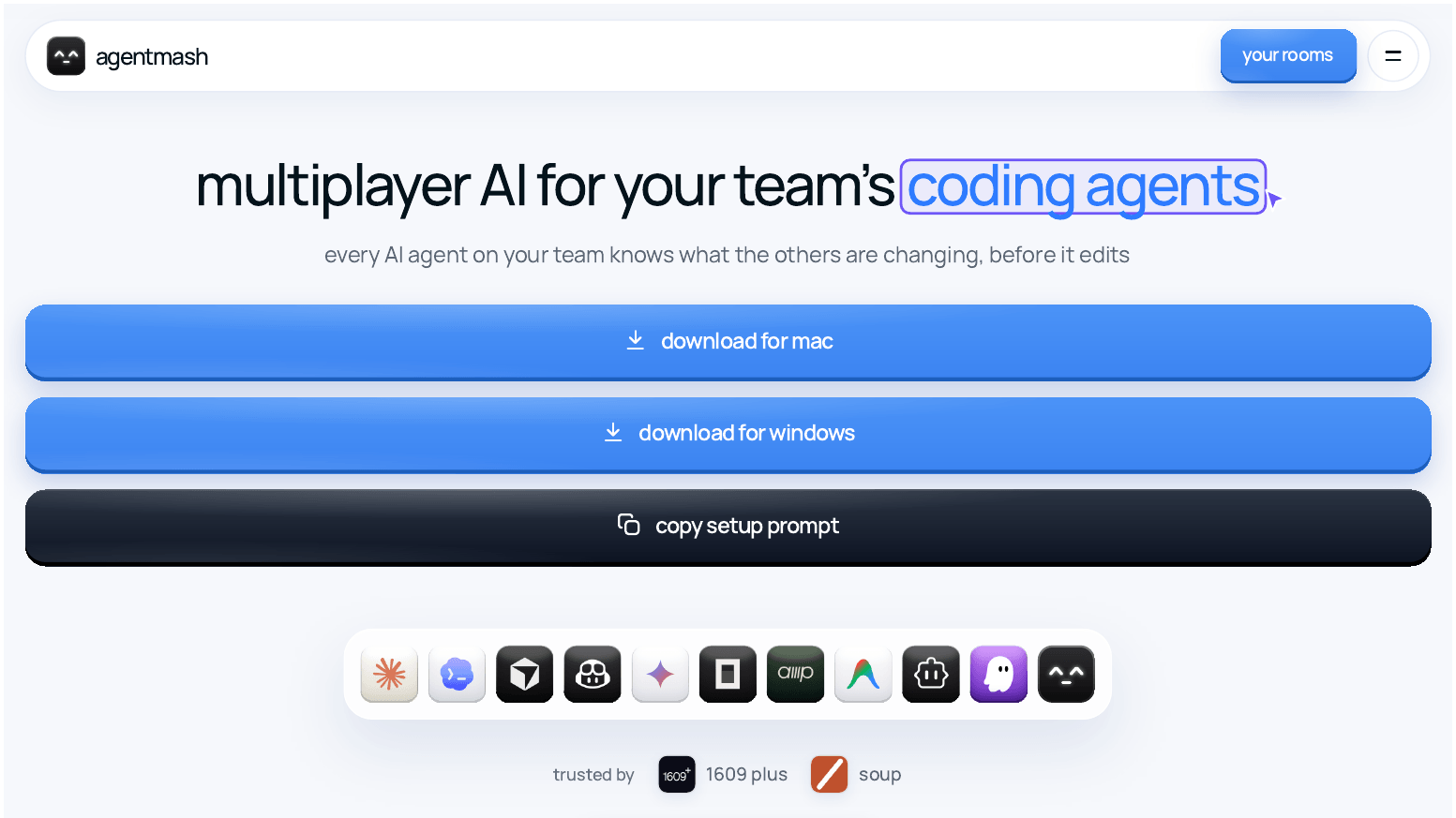
Agentmash promises to stop your team’s AI coding agents from overwriting each other’s work. I signed in with GitHub, connected a public test repo in about a minute, and the room, usage counter and settings all worked. The honest catch is that the headline feature, a live warning when two agents collide, needs a local terminal run and a second person, so I never triggered a real one. My take: the idea is strong and the free tier is real, but solo testers will stare at an empty room.
I tested the free plan on 14 November 2026 with no card, no phone number and no payment. The usage counter stayed at 0.0 of 40 agent-hours through every test, which tells you as much about what I could not do as what I could. If you run two or more coding agents on one repo, keep reading. If you code alone, this review will save you the sign-up.
What Is Agentmash?
Agentmash is an open-source multiplayer layer for team coding agents. It sits between agents like Claude Code, Codex, Cursor, GitHub Copilot and Gemini CLI and warns them before they edit the same files, so parallel agents do not overwrite each other. Teammates can also prompt each other’s agents, but nothing runs until the other person approves. Your code stays on your own machine, and the room only sees file paths, branch names, line counts and prompt snippets.
The company was founded by Alim Dauletbek, 18, from Astana, Kazakhstan, with three co-founders. It launched on Product Hunt on 1 November 2026, where it placed 6th Product of the Day with 142 upvotes and 19 comments. The product also ships 22 ready-made Claude Code subagents and a lobby desktop app for macOS and Windows, with a command line tool only on Linux for now.
Hands-On Test: How Agentmash Actually Performed
In line with our editorial testing policy, sign-in is GitHub OAuth only. There is no email sign-up form anywhere on the site, so a GitHub account is the only way in. After authorising the app with repo scope, Agentmash opened at the install page signed in and ready to connect a repository.
Test 1 was connecting a repo, and it took about a minute. My GitHub account had no repos, so I created a public test repo with a single README commit, and Agentmash listed it at once. Connecting it created a live room instantly. Balance before: 0.0 of 40 hours. Balance after: 0.0 of 40 hours.

Test 2 was walking through the room itself, which took about two minutes. The live view reported 0 working, 0 shared files, 0 edits this hour and the message No agents in this repo right now. The people view, collisions view, changes view, history, settings, usage, access, audit log and data pages all loaded cleanly. Collisions said nobody collided this hour, history showed 0 events, and usage showed 0 developers this month, 0 of 1 private repos, and 0.0 of 40 hours. The balance never moved.

Test 3 was a settings change. I turned code streaming on in the room settings, and the toggle stayed on after a page reload. The changes view still said Nothing streamed yet, because no agent was connected to stream anything.
What I could not test matters more than what I could. Starting a live agent session needs npx agentmash login run on a local machine with a coding agent installed, plus a second person to collide with, and this test ran in a browser only. The only collision warning I saw was the product’s own demo panel. Invites are also inbound only: there is no send-invite control in the web UI, and teammates join through GitHub push access to the repo.
Free Plan vs. Real Pricing (And Hidden Limits)
The free plan is genuinely free: $0, 40 agent-hours per team per month, 1 private repo, unlimited public repos, 7 days of history. At 32 hours you get a warning, and at 40 hours running sessions finish while new harness sessions wait until you upgrade or the month resets. The open-source context layer keeps working either way.
| Plan | Monthly price | Annual price | Key limits |
|---|---|---|---|
| Free | $0 | $0 | 40 agent-hours per team/month, 1 private repo, 7 days history |
| Team | $20 per developer | $16 per developer ($192 per year) | Unlimited agent-hours and repos, 90 days history, audit logs, MCP tools, priority support, first month free |
| Enterprise | Custom | From $15,000 per year | Self-hosting, private Docker image, dedicated support |
Billing runs through Polar, prices are in US dollars, and sales tax or VAT is added at checkout. I found no promo code anywhere on the official pages, only the Team first month free offer. The terms, last updated 12 November 2026, say content you send stays yours, no model usage is sold, and paid plans bill per developer with a 7-day grace period after a failed payment. I found nothing unusual on data use, billing or auto-renewal.

Pros
- Genuinely free tier: $0 with 40 agent-hours a month, no card, no phone number, no payment asked at any point
- Repo connect in a minute: a public test repo connected instantly and the room opened with no setup friction
- Clear usage counter: the account shows exact agent-hours used and the reset date, so you always know where you stand
- Per-developer pricing: you pay for developers, never per agent, which keeps the bill predictable as agent use grows
- Code stays on your machine: the room sees only paths, branches, line counts and prompt snippets
Cons
- Core feature unverified: a real collision warning needs a local terminal run and a second person, so I could not test what the product is for
- Solo testers see an empty room: with no agents connected, every view reports zeros and there is nothing to do
- GitHub only sign-in: there is no email sign-up, so anyone without a GitHub account must create one first
- No Linux lobby app yet: the desktop lobby covers macOS and Windows, while Linux users get the command line only
- Open-source claim is homepage only: the public repo link returned a 404 when checked, so I could not verify it
What Real Users Are Saying
There are no independent user reviews to quote. I found no Agentmash listing on G2, Trustpilot or Capterra, and no discussion on Reddit, Hacker News or X. The Product Hunt launch on 1 November 2026 earned 142 upvotes and 19 comments, and the praise there is for the problem itself: teams running several coding agents on one repo do get overwrites, and a warning before the edit lands is more useful than a merge conflict after it. Commenters also liked that it is open source and works with agents teams already pay for.
The limits are just as honest, and they come from the maker. On Product Hunt, the team admitted detection misses meaning-level changes, such as two agents implementing the same contract differently without touching a shared definition, or REST routes and JSON keys on two sides of the wire. It does not read signatures and it does not run the compiler or tests. Two editorial directories scored it without user data, 7.4 out of 10 from AI Agent Ideas and 3.9 out of 5 from HumanEdge, and both flagged the same point: this is a team tool, not a solo one. The homepage claim that 98.6 percent of overlaps are caught before the conflicting write is the company’s own number, not an independent measurement, so treat it as a claim, not a fact.
Who Should Use Agentmash (And Who Should Skip It)
Use it if you are on a team of two or more developers who already run Claude Code, Codex, Cursor or Copilot on the same repo and have felt the pain of agents overwriting each other. The free tier is generous enough to trial properly, and the per-developer pricing means the bill does not grow with every agent you add. Skip it if you code alone with a single agent, because you will get an empty room and no value. If you only need one agent to behave, Cursor or GitHub Copilot already cover that, and an autonomous teammate like Devin is a different answer to a different problem.
Coderblock AI Review
If you want full-stack web applications with database backends rather than multi-agent coordination, explore our Coderblock AI review.
Frequently Asked Questions
Is Agentmash really free?
Yes. The free plan costs $0, needs no card, and gives 40 agent-hours per team per month, 1 private repo, unlimited public repos and 7 days of history. I signed up and tested it without any payment step.
Does Agentmash add a watermark on the free plan?
No. There is no watermark concept here, and the web UI has no export feature at all. Your code stays on your own machine, and the room only sees metadata about the work.
How much does Agentmash cost per month?
Team costs $20 per developer per month, or $16 per developer per month billed annually at $192 per year, with the first month free. Enterprise starts at $15,000 per year. Billing runs through Polar, with sales tax or VAT added at checkout.
Can you use Agentmash creations commercially?
Yes. The terms say content you send stays yours, and Agentmash does not sell model usage. You bring your own agent logins, and the work your agents produce remains yours.