I tested AI CodeOps on its free open beta, and the short version is this: it is worth trying if you want an AI coding agent that cannot merge code on its own say-so. I signed up with Google, connected no Git account, and still ran a real agent session on a public sample repo. The session finished in 47 seconds, used 16,032 of my 2,000,000 free Economy tokens, and stopped at a human approval gate with nothing merged. That gate is the whole product, and it worked.
The catch is that this is a beta with no published paid prices. Every paid tier on the pricing page reads “After the beta”, the Standard models are locked on the free plan, and opening a pull request needs a Git token I did not connect. If you need a finished price list or a one-click merge today, that will frustrate you. If you want to see whether gated AI coding fits your workflow, the free tier gives you plenty of room to find out.
What Is AI CodeOps?
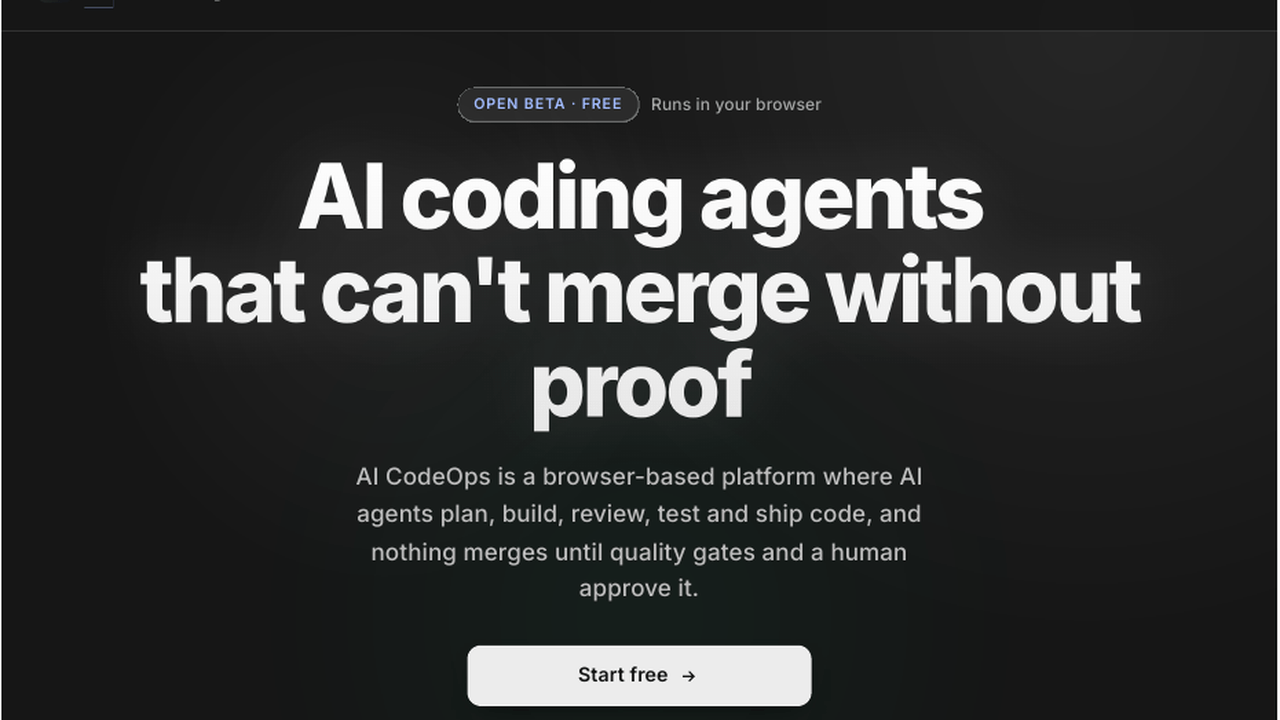
AI CodeOps is a browser-based platform where AI agents plan, build, review, test and ship code on a real repository. It was built by TechInnoHub, launched on Product Hunt on 2 November 2026, and was called CodeOps Studio until October 2026. It works with GitHub, GitLab, Bitbucket, Gitea and Forgejo, including self-hosted servers, and there is nothing to install. Sessions run in hosted sandboxes.
The idea is simple and strict. Every AI change waits at a release gate, and the gate opens a pull request only when three checks pass: your tests passed in a sandbox on that exact version, the AI review of the real diff has no open high or critical findings, and a person approved it. The person who started a session cannot approve it alone when someone else in the workspace can. If a check errors, the gate fails closed. Every change also gets a signed evidence pack, and the site states that your code, prompts and outputs are not used to train AI models.
Hands-On Test: How AI CodeOps Actually Performed
In line with our editorial testing policy, I signed up with Google on 14 November 2026. No card, phone number, or ID check was requested. The dashboard showed a Free plan, a $0.00 balance, 0 active sessions, and 0 Git connections. The Usage page showed Economy 0 of 2M tokens, with Standard marked “Not in your plan”, and a note that the free plan resets on 1 December. The billing page states that billing is not available yet and that workflow dispatch is currently unmetered.
First I walked through the interactive demo, which needs no sign-up and uses pre-scripted sample data for a fictional Acme Corp workspace. It showed a sample checkout redesign session, 128 pipeline runs, a security score of A (92 out of 100) with one open high finding blocking a merge, and DORA metrics of 12 deploys a week with a 4.2 hour lead time. It used no tokens and changed nothing real, so I treat it as a tour, not a test.
Then I ran a real session. Git connections are token-only, with no OAuth button and no demo repo offered, so I connected no Git account and entered no token or password. The project form states that public repos clone fine, so I created a project from the existing public sample repo at github.com/octocat/Hello-World. The access check returned “Reachable, default branch master”, and the project counted as 1 of 3 on the free plan.

At 04:31 EET I started a Plan, Build, Review and Test session with the prompt to add an “About this test” section of 2 to 3 sentences to README.md, change no other file, and run the review and test gate. The run completed in 46.5 seconds across 4 agent steps: Plan 3.8 seconds, Build 2.4 seconds, Review 6.6 seconds, and Test 7.9 seconds, all on the model gpt-oss:120b. It used 16,032 tokens in total (9,880 input, 6,152 output) across 6 API calls, at a stated cost of $0.1219, covered by the free allowance. My balance stayed at $0.00, and the Usage page moved to 16K of 2M tokens, which is 1 percent of the monthly allowance.
The generated diff added exactly what I asked for and nothing else: a heading “About this test” plus two sentences saying this is a small public sample repository used for a hands-on test of AI CodeOps and that no functional code is changed. The review returned 2 findings, both open and neither blocking: an info note about a non-ASCII dash character in the paragraph, and a low note that the repo file is named README rather than README.md. The quality gate read “Release-ready, no blocking findings or test failures”, but with an honest qualifier: the CI release check was “NOT VERIFIED” because no test command was detected on this project, and the test step itself ran by inspection rather than by executing a suite. That is a fair result for a docs-only repo with no test command, and it means the test gate is still unproven on a real code repo in my test.

The run is still waiting at the approval gate. The page shows “Apply AI-proposed changes to test-readme, Accept or Reject: run cannot ship until you decide”, and the Ship button is disabled with “Open Pull Request, approve the changes first”. Opening a pull request also needs a connected Git account, which I did not set up. So nothing was merged and no pull request was opened. I left it unapproved on purpose: approving and merging was not part of the test, and it would need a Git token.
Free Plan vs. Real Pricing (And Hidden Limits)
The free open beta gives you 2M Economy tokens a month, everything in AI CodeOps for your workspace while the beta runs, 3 projects, a 7 day audit log, and support tickets from Help in any workspace. You can also use your own model provider key, in which case sessions consume your provider limits rather than the platform allowance. Standard and Premium models are not included on the free plan, and there is no cost budget or usage-based billing on this tier.
Here is the part that matters most for a buying decision: no dollar price is published anywhere on the pricing page. The Individual and Team tiers both read “After the beta”, with the note that pricing will be announced before the free beta ends. Enterprise is priced per seat, with no figure given. The token allowances for those tiers are published, and they are generous, but a price is not a token count, and I cannot tell you what this will cost when the beta ends. The pricing page also carries a small contradiction worth noting: the comparison table lists a 30 day free trial for the Individual and Team plans, while the FAQ says the Individual trial is 14 days. Both figures are published on the same page, so I report both and trust neither until the company fixes it.
| Plan | Price | Economy tokens per month | Standard tokens per month | Premium tokens per month | Projects | Audit retention |
|---|---|---|---|---|---|---|
| Open beta | Free | 2M | Not included | Not included | 3 | 7 days |
| Individual | After the beta | 10M | 3M | Not included | 10 | 30 days |
| Team | After the beta | 20M | 5M | 1M | 20 | 90 days |
| Enterprise | Per seat, contact sales | Unlimited | 50M | 10M | Unlimited | Unlimited |
Non-commercial open source projects are free forever, with 300 sessions a month and higher limits than the free plan, plus a release-gate badge for the README. The site also mentions a $10 credit top-up provided by request for accounts that do not go through the open beta process. The Terms of Service, effective 11 October 2026, include automatic renewals, binding individual arbitration and a class-action waiver, and Stripe billing for paid services. You keep ownership of your input, content is used only to provide the service, comply with law, or enforce the terms, and output may not be used to develop competing AI models.

Pros
- Real session, real repo: a full Plan, Build, Review and Test run on a public repo finished in 46.5 seconds and followed the brief exactly, changing no other file.
- Generous free allowance: 2M Economy tokens a month, and my whole test used 16,032, which is under 1 percent of it.
- The gate actually gates: the run stopped at human approval with Ship disabled, and the release check failed closed when no test command was found.
- No card to start: Google sign-up took about a minute, with no card, phone, or ID check, and billing is not even enabled yet.
- Wide Git support: GitHub, GitLab, Bitbucket, Gitea and Forgejo, including self-hosted servers, with no install.
Cons
- No published prices: every paid tier reads “After the beta”, so you cannot budget for this tool today.
- Standard models locked: the free plan gets Economy only, and Standard and Premium need a paid tier.
- Token-only Git connection: there is no OAuth button, so connecting a repo means creating and pasting a personal access token.
- Merge path unproven in my test: no pull request could open without a Git token, and the test gate ran by inspection because the sample repo has no test command.
- Trial length contradicts itself: the pricing table says 30 days and the FAQ says 14 days for the Individual trial.
What Real Users Are Saying
There is nothing to report here, and I will not pad it. I checked G2, Trustpilot, Capterra, Product Hunt reviews, Reddit, Hacker News and X on 14 November 2026, and found 0 independent reviews of AI CodeOps. The Product Hunt reviews page shows the listing metadata and no user reviews, no rating, and no review count. No Reddit or Hacker News thread about the product was found, and no verifiable X post was found. The only third-party listings are directories repeating the launch facts, with no user quotes. That is normal for a tool that launched on 2 November 2026, but it means my hands-on test is the only evidence in this review, and you should weigh it that way.
Who Should Use AI CodeOps (And Who Should Skip It)
Use it if you run a small team or an open source project and you want AI-written code held to a visible standard before it merges. The free beta is genuinely usable, the token allowance is large, and the approval gate gives a solo maintainer or a lead a real checkpoint. Open source maintainers should also look at the free-forever offer, which adds sessions and a README badge.
Telemetry Dev Review
If your engineering workflow prioritizes real-time telemetry tracing and agent observability, see our Telemetry Dev review.
Skip it for now if you need a published price before you commit, if your workflow depends on Standard or Premium models, or if you will not paste a Git personal access token into a new beta product. In that case, GitHub Copilot code review, which AI CodeOps itself compares against on its homepage, is the safer known quantity, and you can revisit AI CodeOps once it publishes prices.
Frequently Asked Questions
Is AI CodeOps really free?
Yes, during the open beta. The free plan gives you 2M Economy tokens a month, 3 projects, and everything in the platform for your workspace, with no card required. Paid prices have not been published yet.
Does AI CodeOps add a watermark on the free plan?
No watermark was observed on the generated diff, the run output, or the console in my test, and no export limit was stated or encountered. There is no explicit export function to watermark in the first place.
How much does AI CodeOps cost per month?
That cannot be answered from the official pricing page, because no dollar price is published. The Individual and Team tiers read “After the beta”, and Enterprise is priced per seat on request. Only the token allowances are published.
Can you use AI CodeOps creations commercially?
The Terms of Service say you keep ownership of your input, and output may not be used to develop competing AI models. The open beta is a general free plan, while non-commercial open source projects are free forever. Check the current Terms of Service at aicodeops.dev/legal/terms-of-service before relying on it for commercial work.